- Leader Follower optical coherence tomography1 (LF-OCT) operates like a time domain OCT1, selecting signal from a selected depth while scanning the laser beam across the sample.
Leader Follower is a spectral (Fourier) domain OCT method, hence benefits from the sensitivity and speed advantage of the spectral (Fourier) domain methods in comparison with time domain method1, 3-5. - Leader Follower method allows collection of signals from any number of depths, as required by the user, ie of any number of en-face OCT images, from any depths, separated by any distance from the neighboring en-face slices1, 3-5. LF-OCT does not require resampling of data, hence no linearization, no calibration necessary, no clock needed in the swept source OCT, no linearized spectrometer in spectrometer based OCT1, 3-5.
- LF-OCT is tolerant to dispersion7, so no need to optimize the quantity of glass in the interferometer. Since no data re-sampling is required, the sensitivity at large depths provided by the method proposed is slightly superior to that provided by the FFT based technique1, 3-5. The depth resolution does not depend on the way in which data are sampled, and reaches the theoretical expected limit1, 3-5.
- The Leader Follower method is ideally suited to production of en-face OCT images from any tissue, including the eye, to satisfy the recent revival of interest in the en-face orientation7,8.
- The LF method is ideally suited for parallel computing algorithms on GPUs due to its parallel nature. Recently, we have demonstrated realtime production of LF based B-scan images of the human retina9 as well as a dual modality imaging system en-face SLO/OCT entirely based on LF method 10.
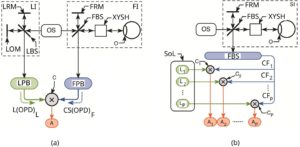
Fig.1 Illustration of the LF principle
(a) Implementation of the LF method using two interferometers, a leader interferometer (LI) and a follower interferometer (FI).
(b) Parallel implementation of the LF principle, where the LI in (a) is replaced with SoL: storage bank of P memories, M1, M2, …MP, a memory for each point in depth in the object, O.
Principle of operation of the LF method illustrated here using a multi-layered object can be found in the following paper: decoding of the depth information can be obtained by comparing the reference (mask) channeled spectrum (mask) with the three channeled spectra (CF1, CF2, CF3) produced by interference between the reference beam and the back-reflected light by the three reflecting structures in the object.
References
Master– Slave (MS) terminology used in previous reports was recently replaced with the more inclusive terminology of Leader-Follower (LF) and
Complex Master Slave as Complex Leader– Follower method (CLF)
- A. Gh. Podoleanu and A. Bradu, “Master-slave interferometry for parallel spectral domain interferometry sensing and versatile 3D optical coherence tomography,” Opt. Express 21, 19324-19338 (2013).
- A. Gh. Podoleanu, “Principles of en-face optical coherence tomography: real time and post-processing en-face imaging in ophthalmology,” (in Clinical en-face OCT atlas, B. Lambruso, D. Huang, A. Romano, M. Rispoli, G. Coscas eds., J.P. Medical Ltd 2013), Chap. 1.
- A. Bradu and A. Gh. Podoleanu, “Calibration-free B-scan images produced by master/slave optical coherence tomography,” Opt. Lett. 39, 450-453 (2014).
- A. Bradu and A. Gh. Podoleanu, “Imaging the eye fundus with real-time en-face spectral domain optical coherence tomography,” Biomed. Opt. Express 5, 1233-1249 (2014).
- K. Kapinchev, F. Barnes, A. Bradu, A. Gh. Podoleanu, “Approaches to General Purpose GPU Acceleration of Digital Signal Processing in Optical Coherence Tomography Systems,” IEEE International Conference on Systems, Man, and Cybernetics (SMC), 2013, 2576-2580, (2013).
- A. Bradu, M. Maria, and A. Podoleanu, “Demonstration of tolerance to dispersion of master/slave interferometry,” Opt. Express 23, 14148-14161 (2015).
- First international congress of en-face OCT, Rome 2013.
- Second International Congress on “En-Face” OCT imaging New Developments in OCT, OCT Angiography, Rome, 2014.
- Adrian Bradu, Konstantin Kapinchev, Frederick Barnes, and Adrian Podoleanu, “On the possibility of producing true real-time retinal cross-sectional images using a graphics processing unit enhanced master-slave optical coherence tomography system,” J. Biomed. Opt., 20, 076008 (2015).
- Adrian Bradu, Konstantin Kapinchev, Frederick Barnes, and Adrian Podoleanu, “Master slave en-face OCT/SLO,” Biomed. Opt. Express 6, 3655-3669 (2015).
Applications of Leader-Follower OCT
LF-OCT has been successfully applied to many different OCT-based applications, including multi-modal imaging and extended-functionality OCT systems.
A number of publications on the Leader-Follower OCT applications can be seen below :
- Electrical Versus Optical Generation of Leader Signals for Downconversion Leader-Follower Optical Coherence Tomography, A. M. Jimenez, R. Cernat and A. Podoleanu, IEEE Photonics Journal, vol. 18, no. 1, pp. 1-14, Feb. 2026, Art no. 0600214 (doi: 10.1109/JPHOT.2025.3646935)
- Balanced-detection visible optical coherence tomography with a low-noise supercontinuum laser, Lucy Abbott, Gianni Nteroli, Rasmus D. Engelsholm, Patrick Bowen Montague, Adrian Podoleanu, Adrian Bradu, Biomedical Optics Express, 16 (7), 2898-2913 (2025) (doi:10.1364/BOE.562672)
- Downconversion Master Slave OCT With a Bidirectional Sweeping Laser , A. Martinez Jimenez, R. Cernat, A. Bradu, R. Riha, E. A. Proano Grijalva, B. O. Meyer, T. Ansbaek, K. Yvind, A. Podoleanu, Journal of Biophotonics, (2024), doi: 10.1002/jbio.202400201.
- Downconversion master slave optical coherence tomography for simultaneous en-face imaging at two depths, Ramona Cernat, Alejandro Martínez Jiménez, and Adrian Podoleanu, Opt. Express 32, 30756-30774 (2024), doi: 10.1364/OE.530325.
- Complex master-slave enhanced optical coherence microscopy, Camard, Julien, Marques, Manuel J., Canedo-Ribeiro, Carla, Silvestri, M., Ellis, Peter J.I., Robinson, Gary K., Chavez-Badiola, Alejandro, Griffin, Darren K., Bradu, Adrian, Podoleanu, Adrian G.H., Optics Continuum, 3 (3). pp. 324-337. (2024) (doi:10.1364/OPTCON.518366)
- 400 Hz volume rate swept-source optical coherence tomography at 1060 nm using a KTN deflector, Alejandro Martínez Jiménez, Sacha Grelet, Veronika Tsatourian, Patrick Bowen Montague, Adrian Bradu, and Adrian Podoleanu, IEEE Photonics Technology Letters 34(23), 1277-1280 (2022) (doi:10.1109/LPT.2022.3212015) [View on KAR]
- Akinetic Swept-Source Master–Slave-Enhanced Optical Coherence Tomography, Manuel J. Marques, Ramona Cernat, Jason Ensher, Adrian Bradu, and Adrian Podoleanu, Photonics 8(5) (2021). (doi: 10.3390/photonics8050141).
- R. Riha, M. J. Marques, M.R.Hughes, A.Bradu, A. Podoleanu, “Direct en-face, speckle-reduced images using angular-compounded Master-Slave optical coherence tomography“, Journal of Optics, IOP, Vol. 22, No. 5, J. Opt. 22 055302, (2020).
- M. Bondu, M. J. Marques, P. M. Moselund, G. Lall, A. Bradu, A. Podoleanu, “Multispectral photoacoustic microscopy and optical coherence tomography using a single supercontinuum source“, Photoacoustics 9, pp. 21-30 (2018).
- S. Caujolle, R. Cernat, G. Silvestri, M. J. Marques, A. Bradu, T. Feuchter, G. Robinson, D. K. Griffin, A. Podoleanu, “Speckle variance OCT for depth resolved assessment of the viability of bovine embryos“, Biomed. Opt. Express 8(11), pp. 5139-5150 (2017).
- S. Rivet, M. J. Marques, A. Bradu, A. Podoleanu, “Passive optical module for polarization-sensitive optical coherence tomography systems“, Opt. Express 25(13), pp. 14533-14544 (2017).
- R. Cernat, A. Bradu, N. M. Israelsen, O. Bang, S. Rivet, P. A. Keane, D. G. Heath, R. Rajendram, A. Podoleanu, “Gabor fusion master slave optical coherence tomography“, Biomed. Opt. Express 8(2), pp. 813-827 (2017).
- C. Chin, A. Bradu, R. Lim, M. Khandwala, J. Schofield, L. Leick, A. Podoleanu, “Master/slave optical coherence tomography imaging of eyelid basal cell carcinoma“, Appl. Opt. 55(26), pp. 7378-7386 (2016).
- A. Bradu, S. Rivet, A. Podoleanu, “Master/slave interferometry–ideal tool for coherence revival swept source optical coherence tomography“, Biomed. Opt. Express 7(7), pp. 2453-2468 (2016).
- J. Wang, A. Bradu, G. Dobre, A. Podoleanu, “Full-field swept source master-slave optical coherence tomography“, IEEE Phot. Journal 7(4), pp. 1-14 (2015).
Master– Slave (MS) terminology used in previous reports was recently replaced with the more inclusive terminology of Leader-Follower (LF) and
Complex Master Slave as Complex Leader– Follower method (CLF)