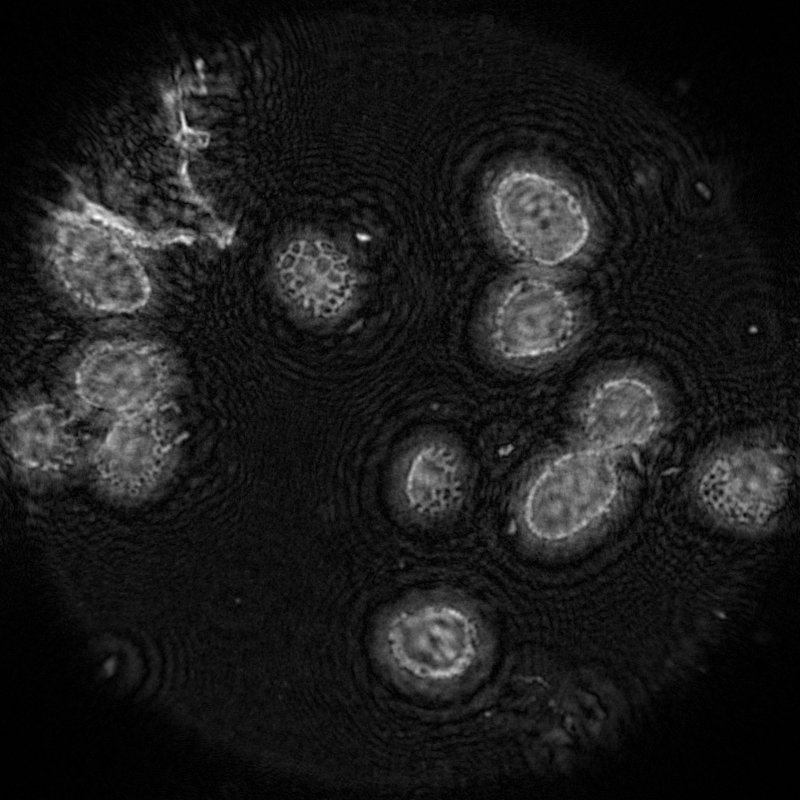
We are developing techniques for capturing holographic microscopy imaging through fibres. By combining fibre-optic imaging with computational holography, we can capture and reconstruct detailed images through extremely thin fibre bundles, creating compact microscopes capable in confined environments.
In inline holography, the sample is illuminated by a laser, and the resulting diffraction pattern is captured directly by a camera. There is no need for a lens, and so this is sometimes called ‘lensless imaging’. We take the diffraction pattern collected on the camera (the hologram) and computationally reconstruct an image of the object by numerically propagating the light back to the plane of the sample. A convenient benefit of this is that we don’t need to choose the focal plane at the time we capture the image, we can decided this retrospectively, or even reconstruct multiple depth planes. This makes holographic microscopy particularly useful for imaging objects in a volume, particularly when they are moving.
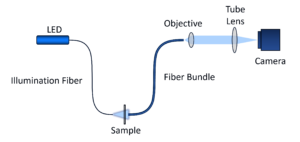
The basic arrangement for holographic microscopy through a fibre bundle.
We have shown that high-quality inline holograms can be captured through fibre imaging bundles, first reported this in 2021 in a paper in Applied Optics (also available as an open-access pre-print). We illuminate the sample from behind using an LED coupled into a small diameter multimode fibre. This strikes a balance between providing sufficient coherence for holography to work, but preventing speckle noise which becomes a major problem when using lasers with fibre bundles (see this proceedings for a more detailed discussion of the trade-offs). Using an LED coupled into a 50 micron core fibre, we achieve a resolution of around 5 microns for samples placed within 2 mm of the fibre bundle.
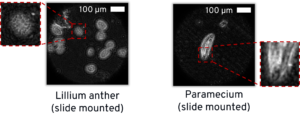
Example images captured with fibre bundle holography.
The resolution close to the bundle can be improved by a factor of two by capturing multiple holograms with the illumination source slightly shifted. We showed in this paper that we can do this in real-time by using multiple illumination fibres, each connected to its own LED, and cycling rapidly through these.
For more information on projects holographic microscopy please see Dr Mike Hughes lab or contact by by email.