Our research project originally stated five hypotheses presented in the table below:
Hard to be a Hero
Featured story
| Initial Hypotheses | |
|---|---|
| H1 | Heroised groups are recipients of symbolic and material gratitude |
| H2 | Heroised groups are shielded from criticism |
| H3 | Heroised groups are less likely to receive support if they are the instigators of the demands |
| H4 | Heroised groups are less likely to be perceived as victims when suffering |
| H5 | Heroised groups are less likely to be perceived as villains when breaking regulations |
The hypotheses were tested through correlational and experimental studies and were updated. In particular, we found support for three of the original hypotheses (H1, H2, H5). In contrast, we found support against H3 and 4: heroised groups are more likely to be perceived as suffering, and more likely to be supported in their demands.
In order to explain these unexpected findings, we updated our hypotheses. In contrast to our hypotheses, heroised groups are more supported in their demands (H3) – this runs against findings that heroic groups are exploited (Stanley & Kay, 2024, study 5). We therefore hypothesise that, despite the perception that heroic groups would willingly accept exploitative policies (H6), participants are less likely to support exploitative policies for heroised workers (H7).
In addition, our findings that heroised groups are perceived as suffering more (H4) further led us to hypothesise that heroised workers are perceived as more willing to suffer (H8). In this view, victims and heroes are similar in the extent to which they would be perceived as suffering — but heroic groups differ from victims in the extent to which this suffering is perceived as chosen.
| Updated hypotheses |
|---|
In another line of research, we evaluated how perceived heroism could also influence moral condemnation of the use of force of workers during a specific mission. We focused on a recent event wherein Brazilian military police officers were accused of an excessive use of force during a deadly police raid in a favela in Rio de Janeiro (see https://www.bbc.co.uk/news/articles/c62012e6g9lo for a coverage of this event).
Collective Heroism Perception scale development
We developed a questionnaire designed to measure all key variables outlined in our hypotheses.
Data and material associated with the full process of scale development is available online on OSF.
The development of the scale followed four phases described below.
___
Phase 1: Initial items pool development
An initial pool of 82 items was generated in February 2025.
Phase 2: Construct validity assessment
A group of 5 experts in moral psychology and heroism study was consulted to provide feedback on the relevance of our items in measuring the target outcomes. Their feedback resulted in a 66-item questionnaire. This phase was completed in March 2025.
Phase 3: Face validity assessment
A group of 20 naive UK residents evaluated the clarity of each item of the 66-items version of the scale. Their feedback led to a 54-item questionnaire. See Detailed Report on the Face validity assessment. This protocol was completed in April 2025.
Ethics: ID 202517441056499963 (Approved Apr 8, 2025)
Phase 4: Reliability and Structure assessment
We asked 440 participants (representative UK sample) to complete the 54-item questionnaire. We then assessed the reliability (i.e., MacDonald’s omega) and the structure of the survey using Exploratory Factor Analyses. Our analyses led to a 21-item final scale that will be used for our research project. This study was completed in May 2025.
Ethics: ID 202517473026909997 (Approved May, 15, 2025)
Key elements
- Sample: Total 460 UK residents + 5 experts
- Target occupations: Police officers
- Results: We successfully validated a scale measuring main outcomes predicted to correlate with perceived occupational heroism.
Links
Heroism and Acceptability of Rule Breaking
We surveyed 300 participants (representative UK residents) and asked them to evaluate the heroism and their support for de-regulating the occupations and protecting them from consequences upon breaking the rules. We found that heroism predicted support for deregulating occupations above and beyond attitude, across all six target occupations (journalists, underwater welders, psychiatrists, nurses, firefighters, and soldiers). Looking at occupations individually, we observed especially large effect sizes for soldiers and journalists (two occupations that can be described as villains by some participants). In contrast, nurses did not appear to derive a similar moral shield from their heroic status.
Key elements
- Ethics: # 2025175682910010087 (Approved September, 02, 2025)
- Sample: 300 UK residents (representative sample)
- Manipulation: Target Occupation
- Design: Between-participants
- Target occupations: Journalists; Underwater welders; Psychiatrists; Nurses; Firefighters; and Soldiers
- Results: Across all occupations, perceived heroism was related to a support for workers’ impunity (i.e., de-regulating occupations and protecting the workers from consequences following breaking the rules).
Links
Full report
Data, Codes, Material
Pre-registration
The Poppy effect: how remembrance day celebrations influence the moral shielding of heroes?
We assessed the effect of remembrance day celebrations by replicating the previous study (see above) during the week of remembrance day (i.e., 4th November – 11th November). We assessed perceptions of soldiers, and two control occupations (nurses and underwater welders), to compare the replication with the previous original sample. We expected soldiers (but not the other occupations) to be more heroised during remembrance day celebrations. We also expected them to be more shielded from criticism, and to be more protected from consequences associated with rule-breaking. We successfully replicated the previous findings: heroism was associated with a moral shield.
However, we did not find any of the expected consequences of remembrance day celebrations: soldiers were not more heroised in this new sample, compared to the previous one. Moreover, hate speech and criticism toward soldiers appeared to be more acceptable during remembrance day celebrations. Participants completing our scale during the remembrance day celebrations also appeared to be less in favour of de-regulating the occupation. If anything, our results indicate that commemorations of veterans associated with remembrance day might weaken the moral shield associated with heroism. Further studies should be conducted to understand the mechanisms underlying this unexpected poppy effect.
Key elements
- Ethics: # 2025176216679410143 (Approved November, 03, 2025)
- Sample: 421 UK residents (representative sample) compared with previously collected data (original N = 417)
- Manipulation: Target Occupation and Time of data collection
- Design: Between-participants
- Target occupations: Underwater welders; Nurses and Soldiers
- Results: Although we replicated the correlations previously observed – we did not find any evidence that remembrance day commemorations influenced perceived occupational heroism of soldiers, nor any outcomes relating to occupational heroism.
Links
Correlates of perceived heroism
In a large correlational study (N = 840), we assessed the correlates of perceived heroism across 6 occupations (firefighters, soldiers, nurses, psychiatrists, underwater welders, and journalists). We found strong correlational support for the following original hypotheses:
- Heroised groups are the recipient of gratefulness
- Heroised groups are shielded from criticism and hate speech
- Heroised groups are shielded from consequences of rule-breaking through increased support for de-regulating heroised occupations, and support for protecting rule-breakers from legal prosecutions
In contrast to our initial hypotheses, we found strong correlational support that:
- Heroised groups are perceived as suffering more
- Heroised groups are more likely to be supported in their demands for improving their work conditions
Following this correlational studies, we updated our hypotheses (see Table 2).
The study was registered. Full details on our analyses can be found online.
Key elements
- Ethics: # 2025175820653410122 (Approved September, 18, 2025)
- Sample: 840 UK residents (representative sample)
- Manipulation: Target Occupation
- Design: Between-participants
- Target occupations: Firefighters, Soldiers, Nurses, Psychiatrists, Underwater welders, and Journalists
- Results: Perceived occupational heroism was associated with increased gratitude, decreased criticism acceptability, and increased support for workers’ impunity. However, in contrast to our initial hypotheses, perceived occupational heroism was associated with increased support for workers’ demands, and increased perceived victimisation of the workers.
Links
Causal effects of Heroism on our predicted outcomes
Using the manipulations of heroism validated as part of the project (see Causes), we evaluated the causal effects of framing occupations as exposed to risk and helpful (two manipulations that were proved to significantly influence the perception of heroism across several occupations) on our updated hypotheses. We evaluated our hypotheses using two neutral occupations that were shown to be perceived as more heroic when describing them as exposed to risk or helpful (Underwater welders and psychiatrists).
Our findings regarding each of our hypotheses are summarised below:
H1. Gratitude
Participants expressed greater gratitude toward occupations framed as exposed to risk or helpful.
H2. Shielding from criticism
Participants were more likely to shield occupations framed as exposed to risk or helpful from criticism, although this effect emerged only for the general-level measure.
H3. Support for workers’ demands
Participants were more likely to support demands from occupations framed as exposed to risk, but not those framed as helpful, and this effect emerged only for the specific-level measure.
H4. Perceived suffering
Participants were more likely to perceive workers from occupations framed as exposed to risk as suffering (but not those framed as helpful).
H5. Protection of rule-breaking workers
Participants were more likely to support protecting rule-breaking workers from occupations framed as exposed to risk, but not those framed as helpful, and this effect emerged only for the general-level measure.
H6. Perceived acceptance of exploitative policies
Participants were more likely to perceive workers from occupations framed as exposed to risk or helpful as willing to accept exploitative policies.
H7. Support for exploitative policies
Participants were less likely to support exploitative policies for workers from occupations framed as exposed to risk, but not those framed as helpful.
H8. Perceived willingness to endure pain
Participants were more likely to perceive workers from occupations framed as exposed to risk as willing to endure greater pain, but not those framed as helpful, and this effect emerged only for the general-level measure.
______
Key elements
- Ethics: # 2026177151095310280 (Approved February, 19, 2026)
- Sample: 840 UK residents (representative sample)
- Manipulation: Target Occupation, Risk (vs Boredom), Helfulness (vs No helpfulness)
- Design: Between-participants
- Target occupations: Psychiatrists, and Underwater welders
- Results: Overall, framing occupations as exposed to risk produced broader and more consistent effects than framing them as helpful, increasing gratitude, protection from criticism, support for workers’ demands, perceived suffering, protection of rule-breaking workers, perceived willingness to accept exploitation, and willingness to endure pain, while reducing support for exploitative policies. Helpfulness framing mainly increased gratitude and perceived willingness to accept exploitative policies, with little evidence for the other outcomes. Most effects were small and often depended on whether outcomes were measured at the general or specific level; although many were explained by more favourable attitudes toward the occupation, several risk effects remained after accounting for attitude.
Links
Full report
Data, Codes, Material
Pre-registration
Moral condemnation of military police officers' use of force in Brazil
In this study, we decided to extend our findings to a new population. We investigated the perception of military police officers in Brazil, focusing on a specific episode of use of force (i.e., a deadly raid in Rio de Janeiro which resulted in more than a hundred death). The aim of the study was also to test a direct manipulation of heroism (following the approach, Stanley & Kay, 2024).
We recruited 581 Brazilian respondents. Participants were randomly assigned to either a description of the recent use of force of the officers where the word ‘Heroic’ was attached to each mention of the police officers or a description omitting the word ‘Heroic’ (e.g., ‘the heroic military police officers’ vs ‘the military police officers’). In addition, in the heroic condition, a comic-style depiction of an officer with a super-hero cape was attached to the vignette; whereas in the control condition, there was the same comic-style image but without the cape.
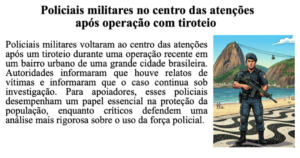
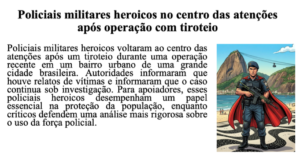
After reading the description, participants completed a Portuguese version of our heroism scale – as used in the previous study (see Causal effects of Heroism on our predicted outcomes). In addition to our measures, we added four items measuring the moral condemnation of this use of force.
_________
Key elements
- Ethics: # 2026177573589810576 (Approved October, 14, 2025)
- Sample: 581 Brazilian residents
- Manipulation: Heroic framing
- Design: Between-participants
- Target occupations: Brazilian military police officers
- Results:Although we did not find evidence supporting that our manipulation influenced perceived occupational heroism, as well as any other heroism-related outcomes in the scale – we found a significant effect of the heroic framing on moral condemnation of the use of force. This could suggest that our framing, despite not changing the perception of the workers – might have influenced the perception of the specific episode covered in the manipulation. In addition, correlational analyses replicated observations in UK samples, emphasising the generalisability of our correlations between perceived occupational heroism and the outcomes of our heroism scale.
Links