Hard to be a Hero

Featured story

Causes of Heroism Perceptions

Some occupations are naturally seen as more heroic than others. Following definitions of heroes as selfless and brave individuals, occupations such as firefighters might stand out as more likely to be classified as heroic than other occupations such as psychiatrists. Nevertheless, we witnessed in recent years that, in novel situations, it is possible to cast occupations not typically perceived as heroic into this frame.

The observation that overworked, under-equipped workers in situations of crises might become heroes prompts us to assess how malleable heroism perceptions are. This work is directly relevant to media and communication, and is also critical in mitigating possible negative consequences associated with the heroic rhetoric sometimes deployed in the media.

Franco et al. (2011) provided the general and, by their own admission, overly simplistic definition of heroism as “to act in a prosocial manner despite personal risk” (p. 99). Altruism and exposure to danger are indeed two core elements that are consistently found in the lay people’s prototype of a hero (Kinsella et al., 2015).

We conducted a series of studies aiming to manipulate heroism perceptions in a subset of occupations. We hypothesise that we can influence perceptions of heroism by emphasising 1) exposure to physical danger and 2) helpfulness in an array of occupations.

Furthermore, we consistently found in previous correlational surveys that – contrasting with the expectations that being perceived as heroes would inhibit the perception of workers as victims – occupational heroism was positively related with perceived victimisation. This unexpected finding prompted us to see how describing workers as suffering (or not suffering) in a courageous (or not courageous) manner could cast them either as victims or as heroes. In other words, we investigated how suffering is common to both victims or heroes – but it is the courage manner in which suffering is experimented which distinguishes between the two moral characters.
List of studies in Axis 1.

Study number Manipulation type IV names Sample size Brief findings
Study 1a List of bullet points Physical (vs Psychological risk) & Altruistic (vs Self-centered) motivations 600 (UK representative sample) Initial test, unsuccessful
Study 1b Narrative descriptions Exposure to danger (vs boredom) and altruistic (vs self-centered) motivations 1340 (UK representative sample) Testing an other approach, partial success
Study 1c Narrative descriptions Altruistic (vs self-centered) motivation and Altruistic (vs Non altruistic) outcome 816 (UK representative sample) Improving previous protocol
Study 2 N/A Perceived heroism, bravery, selflessness, exposure to danger, helpfulness 430 (UK representative sample) Successfully confirmed universality of risk and altruism in predicting heroism

Study 1a. Bullet Points approach

In this study, a representative sample of 600 UK residents had to evaluate five target occupations: Nurses, Soldiers, Firefighters, Police officers, and Psychiatrists. Using three bullet points, the occupations were presented as either being confronted with physical danger (versus psychological pressures) and being motivated by altruism (vs self-centered motivation).

For each occupation, they were then asked to evaluate selflessness, bravery, exposure to danger, and helpfulness of the occupation – as well as their perceived heroism.

We failed to observe any effect of the bullet point presentations on perceptions of heroism.

_________________

Key elements

  • Ethics: # 202517374660439665 (approved Jan 01, 2025)
  • Sample: 600 (representative UK sample)
  • Manipulation type: Three bullet points (a general description, a description of the exposure to physical risk [vs psychological pressure], a description of their altruistic [vs self-centered] motivation)
  • Design: Within-participants (all participants saw all occupations)
  • Target occupations: Healthcare workers; Soldiers; Firefighters; Police officers; Psychiatrists
  • Results: Manipulation checks indicated that our protocol failed to manipulate perceptions of bravery and selflessness, as well as heroism.

Links

Full report
Data, Codes, Material
Pre-registration

Study 1b. Narrative vignettes approach

Following our failure to develop an effective manipulation of risk and selflessness, we decided to change our approach. We identified the following weaknesses in our previous manipulation attempt: 1) the bullet points do not emphasise our manipulation enough, as they do not contradict prior knowledge about the occupation, 2) some target occupations might be associated with strong stereotypes, making it hard to change a person’s mind, 3) Contrasts in our risk manipulation (physical vs psychological risk) might not be large enough (and it is possible that psychological risks also foster perceptions of heroism). 

We decided to implement the following changes: 

  • Manipulations were replaced by text vignettes instead of bullet points displayed in a randomised order  
  • Target occupations: Nurses, Police officers, Firefighters, Psychiatrists and Underwater welders (an occupation less known than the others).  
  • The risk manipulation now contrasts No vs High risk conditions instead of psychological vs physical risk conditions  
  • Occupation type is now manipulated between-participants rather than within-participants

_________________

Key elements

  • Ethics: # 202517425163519922 (approved Mar 21, 2025) 
  • Sample: 1360 UK residents (representative sample) 
  • Manipulation: Narrative descriptions emphasising exposure to physical risk (vs boredom) and altruistic (vs self-centered) motivations
  • Design: Between-participants
  • Target occupations: Nurses; Firefighters; Police officers; Psychiatrists; Underwater welders 
  • Results: We successfully manipulated heroism overall. Looking within specific occupations showed that we changed the perception of 3 out of 5 groups: Firefighters, Underwater welders, and Psychiatrists. In particular, whereas our manipulation of risk was effective in changing the perception of heroism in these groups, our manipulation of selflessness had little to no effect on perceptions of heroism.

Links

Full report
Data, Codes, Material
Pre-registration

Study 1c. Manipulating Altruistic outcome

In the previous study, we tried to manipulate the perception of risk (IV1) and altruism (IV2) for different occupations. Although the manipulation of risk was associated with the expected results in at least 3 occupations (Firefighters, Underwater welders, and Psychiatrists), our manipulation of altruism resulted in small effect sizes (all Cohen’s d < 0.3) and mixed success (i.e., the manipulation only influenced perceptions of heroism for underwater welders and psychiatrists). Additional explorations indicated that the relative success of the manipulation might be accounted for by a more general effect on attitude, rather than a direct effect on perceptions of heroism. Moreover, when assessing the competitive effects of evaluations of exposure to danger, bravery, selflessness, and helpfulness (i.e., actual altruistic outcome), we observed that heroism was principally explained by helpfulness (partial η² = 13%) above and beyond selflessness (partial η² = 5%).

Taken together, these results indicate that heroes might be individuals who help people, rather than individuals who act selflessly. It might be more about the actual outcome, rather than the motivation. Because our previous manipulation focused on emphasising selfless motivations in the occupations, we want to adjust the manipulation to reflect the fact that, above and beyond wanting to help, target occupations are helpful (as opposed to not being helpful).

Key elements

  • Ethics: # 202517490371159993(approved Apr 06, 2025) 
  • Sample: 816 UK residents (representative sample) 
  • Manipulation: Narrative descriptions emphasising altruistic motivations (vs non-altruistic motivations) and altruistic outcomes (vs non altruistic outcomes)
  • Design: Between-participants
  • Target occupations: Firefighters; Psychiatrists; Underwater welders 
  • Results: We successfully manipulated heroism overall. Describing an occupation as associated with altruistic outcomes (i.e., effectively helping people) produced a larger effect size than describing an occupation as associated with altruistic motivation (i.e., wanting to help people). Looking within specific occupations showed that altruistic outcomes explained heroism perceptions among psychiatrists and welders, but not firefighters. Taken together, this study underlines that collective heroism is about being helpful to people above and beyond being driven by selfless motivations.

Links

Full report
Data, Codes, Material
Pre-registration

Study 2 - 50 shades of Heroism

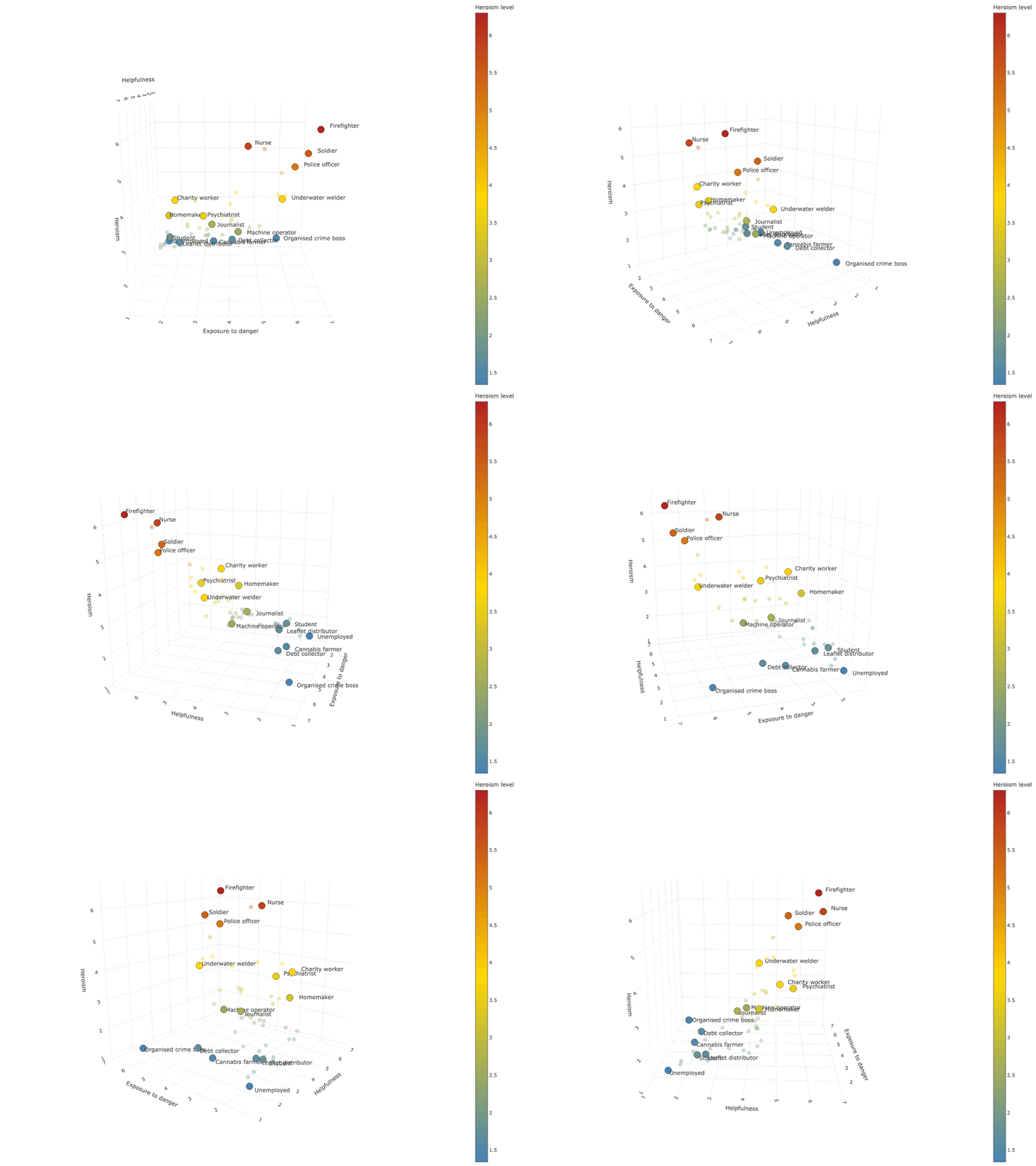
An exploratory project assessing the ‘universality’ of an heroic pattern qualified by bravery, selflessness, exposure to danger, actual helpfulness, across a representative selection of 53 occupations.

We constructed our sample of occupations by stratifying a larger sample of 580 occupations that were evaluated by large representative UK samples on the basis of their social value (see Newlands & Lutz, 2024). We selected 53 occupations covering all major professional domains and ensuring heterogeneity in social values of the selected occupation (see OSF webpage for details on the procedure).

We asked 430 participants to assess each occupations on the following dimensions: Perceived heroism, bravery, selflessness, exposure to danger, and helpfulness (randomised order). After rating each occupation on these dimensions, they reported their attitude toward each occupations.

Our analyses indicate high cohesion between each main variable of the study. Even when partialling out attitude (to account for a possible Halo effect), correlations between each component of heroism and heroism ranged from r = .39 to r = .72 — indicating that our model of heroism is highly satisfactory. Please consult the report of the study for beautiful data visualisations.

_________________

Key elements

  • Ethics: # 2025175137983710040 (approved Mar 21, 2025) 
  • Sample:  430 UK residents (representative sample) 
  • Variable: Occupation type (53 occupations)
  • Design: Within-participants 
  • Results: We successfully identified a three-dimensional structure of perceived occupational heroism, mapped onto perceived helpfulness/selflessness and perceived exposure to risk/bravery.

Links

Full report
Data, Codes, Material
Pre-registration

Heroism is mapped onto helpfulness and exposure to risk.

Study 3 - Heroic Suffering of the Workers

Previous correlational observations emphasised that perceptions of being victims are positively correlated with perceptions of being heroes. Moreover, occupational heroism is positively associated with perception that workers are victimised. As such, the image of the hero might not be one of a strong, powerful, invulnerable character – but on the contrary, one of a vulnerable, suffering, character. Would Superman still be a hero if kryptonite did not offer any possibility to neutralise him? Would Sam and Frodo be heroes if they advanced towards Mordor with the help of giant eagles? It is possible that characters become heroic, because they suffer.

However, the distinction between the hero and the victim, if it does not lie with the experience of suffering – might be related to the way they experience suffering. Heroes and victims are assumed to differ in agency (see Blake et al., 2023). Whereas a victim is passively suffering and presumably motivated to escape the suffering, we hypothesise that heroes would actively choose to suffer if it meant finishing their mission. In other words, heroism might not be about not suffering (as initially expected), but about choosing to suffer when the mission requires it. In a word, courage.

In this study, we attempted to manipulate heroism by casting three occupations (nurses, soldiers, and underwater welders) as either physically suffering, or psychologically suffering, or not suffering. We also manipulated courage using descriptions of the workers as accepting leaves from their work when suffering occured, or refusing leaves in order to continue their mission. We hypothesised that descriptions of suffering (either psychological or physical) would increase perceived heroism and perceived victimhood; however descriptions of courage would only increase perceived heroism but not perceived victimhood. Finally, we expected the effect of suffering to increase perceived heroism, especially in the ‘courageous’ condition. We expected the effect of suffering to increase perceived victimhood, especially in the ‘no courage’ condition.

We recruited a representative sample of 1200 UK participants. They were randomly allocated to one of the three target occupations, and randomly allocated to one of the 3 (suffering type) x 2 (courage) conditions. After reading the descriptions of the target occupation, they completed scales assessing perceived heroism, and perceived victimhood. In addition, they completed measures of the perception that workers are 1) more likely to endure suffering for the sake of their mission, 2) more perceived as victimised, 3) more perceived as likely to be vulnerable (Assumption of vulnerability, see Womick et al., 2026).

_________________

Key elements

  • Ethics: # 2026177480585310545 (approved Mar 21, 2025) 
  • Sample:  1200 UK residents (representative sample) 
  • Variable: Occupation type, Suffering (psychological vs physical vs no suffering), Courage (Courage vs No courage)
  • Design: Between-participants 
  • Results: Our manipulations failed to influence perceived heroism and victimhood of the target workers. However, additional correlational analyses provided support for our theoretical claims. Consistent with our expectations, while both perceived heroism and perceived victimhood are predicted by perceived suffering (either physical or psychological) – suffering ceases to predict heroism when perceived courage (or bravery) is used as a covariate. A similar suppression of the effect of suffering when using courage as a covariate did not occur when using perceived victimhood as an outcome. In this latter model, courage did not predict perceived victimhood, but suffering still did.

Links

Full report
Data, Codes, Material
Pre-registration