29 September 2026
What does it take to build research capacity in social care in a way that is genuinely fair and inclusive? That was the question at the heart of an online webinar on Equality, Diversity and Inclusion (EDI) in research–practice partnerships. The webinar took place on 23 September 2025, was hosted by Social Care Wales and organised by the Kent Research Partnership.
It brought together people from the NIHR-funded social care research–practice partnerships, along with social workers, researchers and care organisations. Together we explored how EDI principles can be built into everything the partnerships do, rather than added on at the end.
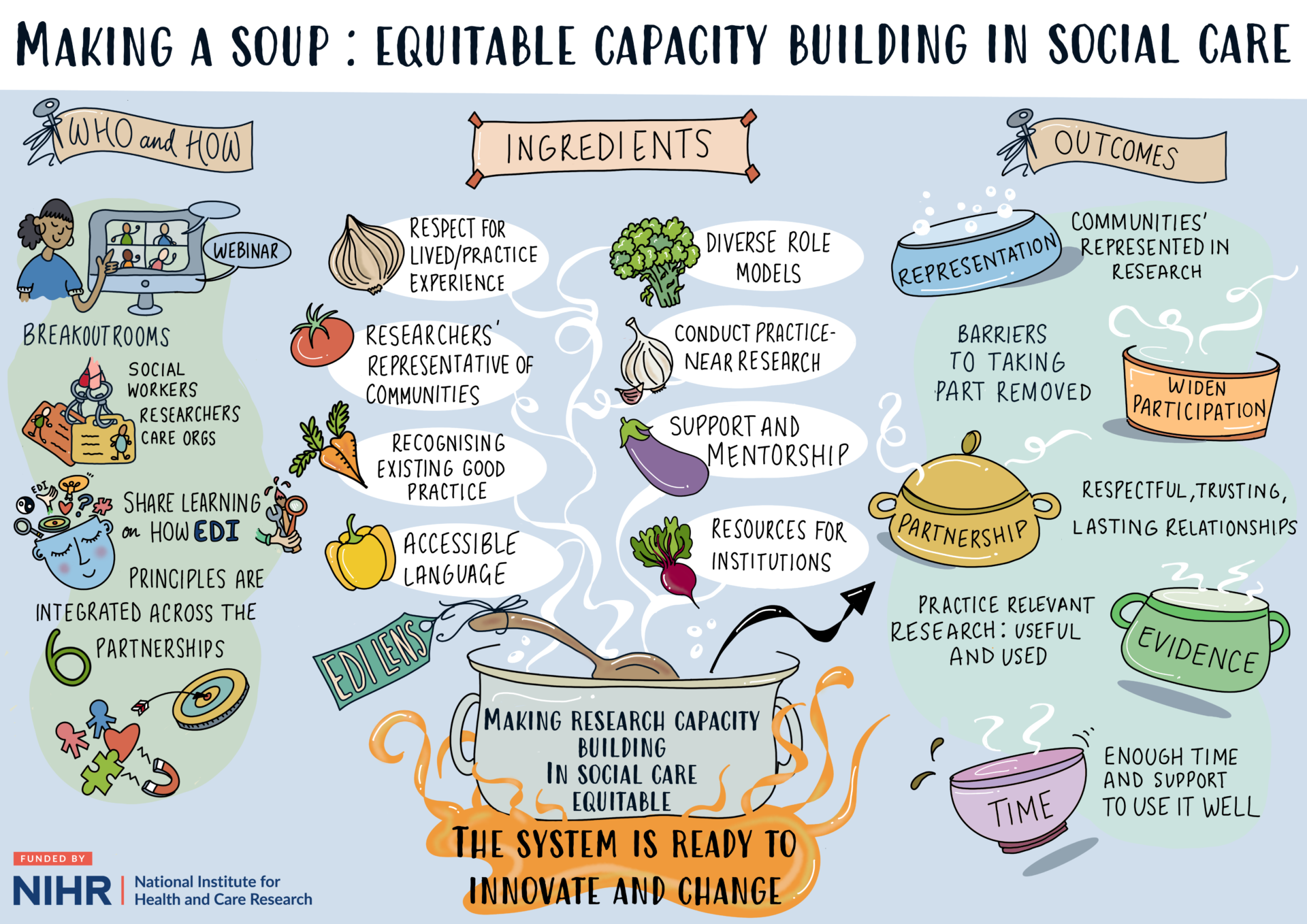
To capture what we learned, we worked with illustrator Julie Dosad to turn the discussion into a picture. We decided to make a soup.
Why a soup?
Good research capacity building, like a good soup, depends on the right ingredients, enough time on the heat, and people who care about what they’re making. No single ingredient does the job on its own. The flavour comes from how everything works together.
Who and how
The webinar mixed short talks and conversations with plenty of time for everyone to contribute. It began with an introduction to research–practice partnerships, followed by a scene-setting conversation on building research capacity in the social care workforce while keeping equality, diversity and inclusion at the centre. Some short “talking provocations” then opened up the discussion.
Much of the work happened in breakout rooms, where social workers, researchers and people from care organisations shared learning on how EDI principles are being integrated across the six partnerships. We first explored the issues that matter most, then moved on to practical ideas that could make a lasting difference.
The ingredients
The illustration sets out the ingredients that came up again and again in the discussion:
- Respect for lived and practice experience: valuing what people bring from their own lives and work.
- Researchers who are representative of the communities they work with.
- Recognising existing good practice, rather than assuming everything has to start from scratch.
- Accessible language, so research is open to everyone, not just those who speak its jargon.
- Diverse role models, so more people can see themselves doing research.
- Practice-near research, rooted in the real-world settings where care happens.
- Support and mentorship for all, especially those who are new to research.
- Resources for institutions, so organisations have what they need to support staff.
All of this is stirred through an EDI lens, a reminder that equity isn’t a separate ingredient but something that shapes how everything else is prepared.
Turning up the heat
At the centre of the picture is the pot itself: making research capacity building in social care equitable. Beneath it is the heat that makes change possible, a system that is ready to innovate and change. Without that heat, even the best ingredients won’t come together.
What we hope to serve up
On the right of the illustration are the outcomes we’re aiming for, each served in its own dish:
- Representation: communities are represented in research.
- Widening participation: barriers to taking part are removed.
- Partnership: respectful, trusting and lasting relationships.
- Evidence: research that is relevant to practice, useful and actually used.
- Time: enough time, and enough support, to do it well.
What next?
The soup is a reminder that equitable capacity building isn’t a single project or a box to tick. It’s an ongoing process that needs the right people, the right conditions and time. We hope the illustration will be a useful conversation starter for teams, partnerships and organisations thinking about how to make social care research more inclusive.
Click on the image to open the inforgraphic:
To cite this document, please use:
Dosad, J., Hotham, S., Mikelyte, R. & Towers, A-M., on behalf of the social care partnerships, Social Care Wales, and IMPACT (2026). Making a soup: Equitable capacity building in social care [Illustration]. University of Kent, Canterbury.
This illustration was produced by Julie Dosad, with input from Sarah Hotham, Rasa Mikelyte and Ann-Marie Towers. The illustration draws on learning shared in a webinar on Equitable Capacity Building in Social Care Research, hosted by Social Care Wales on 23 September 2025 and organised by the Kent Research Partnership, with funding from the National Institute for Health and Care Research (NIHR) Health and Social Care Delivery Research Programme (NIHR13137). We would like to acknowledge the contributions of our collaborators, including:
Kathryn Almack, Principal Investigator, Social Care Research in Practice Teams (SCRiPT) project (University of Hertfordshire)
Yvonne Birks, Principal Investigator, The Curiosity Partnership (University of York)
Annette Boaz, Principal Investigator, Creating Care Partnerships project (King’s College London)
Christie Cabral, Principal Investigator, ConnectED (University of Bristol)
Lida Efstathopoulou, Researcher in Residence, Social Care Research in Practice Teams (SCRiPT) project (University of Hertfordshire)
Sophie Fournel, Chief Executive Officer, Disability Assist for Independent Living Ltd, and former Research and Training Fellow, Kent Research Partnership (University of Kent)
Jon Glasby, Director, IMPACT – the UK centre for implementing evidence in adult social care
Kate Howson, Senior Partnerships Lead (Research), Social Care Wales
Geraldine Macdonald, Principal Investigator, ConnectED (University of Bristol)
Rachel Scourfield, Head of Knowledge Mobilisation, Social Care Wales
Rod Sheaff, Principal Investigator, Peninsula Adult Social Care Research Collaborative (PARC) (University of Plymouth)
Penelope Welbourne, Principal Investigator, Peninsula Adult Social Care Research Collaborative (PARC) (University of Plymouth)
Mark Wilberforce, Director, The Curiosity Partnership (University of York)