Half of Gen Z and Millennials expect they won’t be able to retire until their 70s or even later
Key takeaways
- A new University of Kent survey explores when people in Great Britain want — and expect — to retire
- Younger people would prefer to retire in their 50s or 60s
- But many Gen Z and Millennials expect to still be working into their 70s or beyond
People now expect to work for much longer
Deciding when to retire used to be relatively straightforward. Men typically stopped working at 65, and women at 60. You’d stop making National Insurance contributions and leave your working life behind you. Retirement closely followed the State Pension Age (SPA), which acted as a powerful social norm.
Twenty years ago, most people expected to retire at the SPA (60 for women and 65 for men). Only around 5 per cent expected to retire after 65, while a substantial minority expected to retire earlier.¹
But this has changed. As people live longer, they need to work — and save — for more years than previous generations. Today, most people have to wait until at least 66 to receive the State Pension, and this age is set to rise further. As a result, the idea of a fixed ‘retirement age’ is becoming less clear-cut.
On the one hand, there will inevitably be some who feel that having to wait longer for a State Pension is unfair. On the other hand, there is potential for extending working life to be seen as a positive option, both for the individual and for the economy. Some people may work longer by choice, while others may feel they have little alternative.
What is clear is that expectations are changing.
Expectations about retirement age matter because they shape when and how much people save for their pension, and how they plan for later life.2 Our new data (Figure 1) shows that younger people are far more likely to expect to retire in their 70s or later.
Figure 1. “At what age do you EXPECT to be able to stop working and retire?”
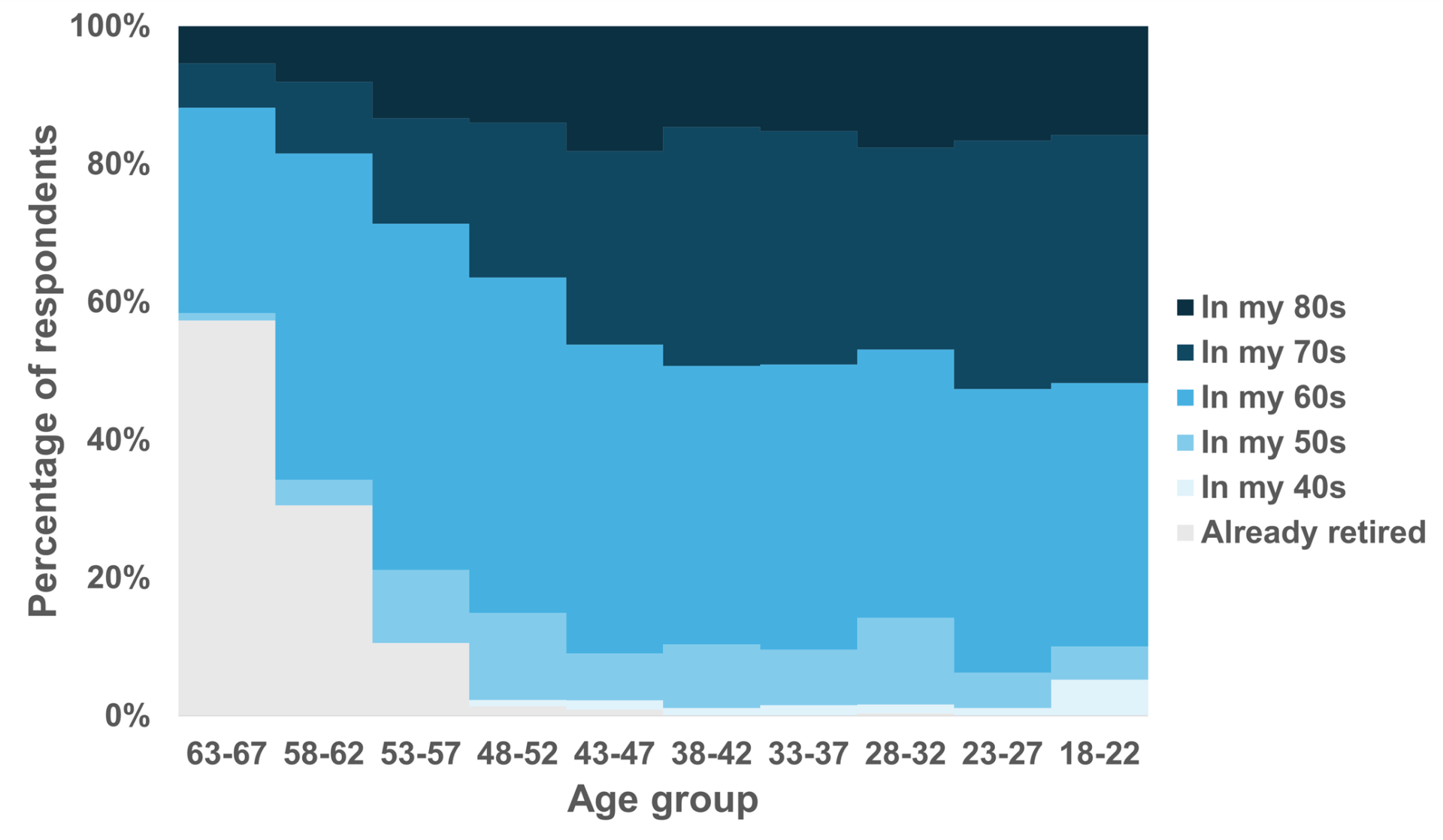
Source: Authors’ calculations.
But they still want to retire earlier
Despite these shifting expectations, people’s preferences tell a different story.
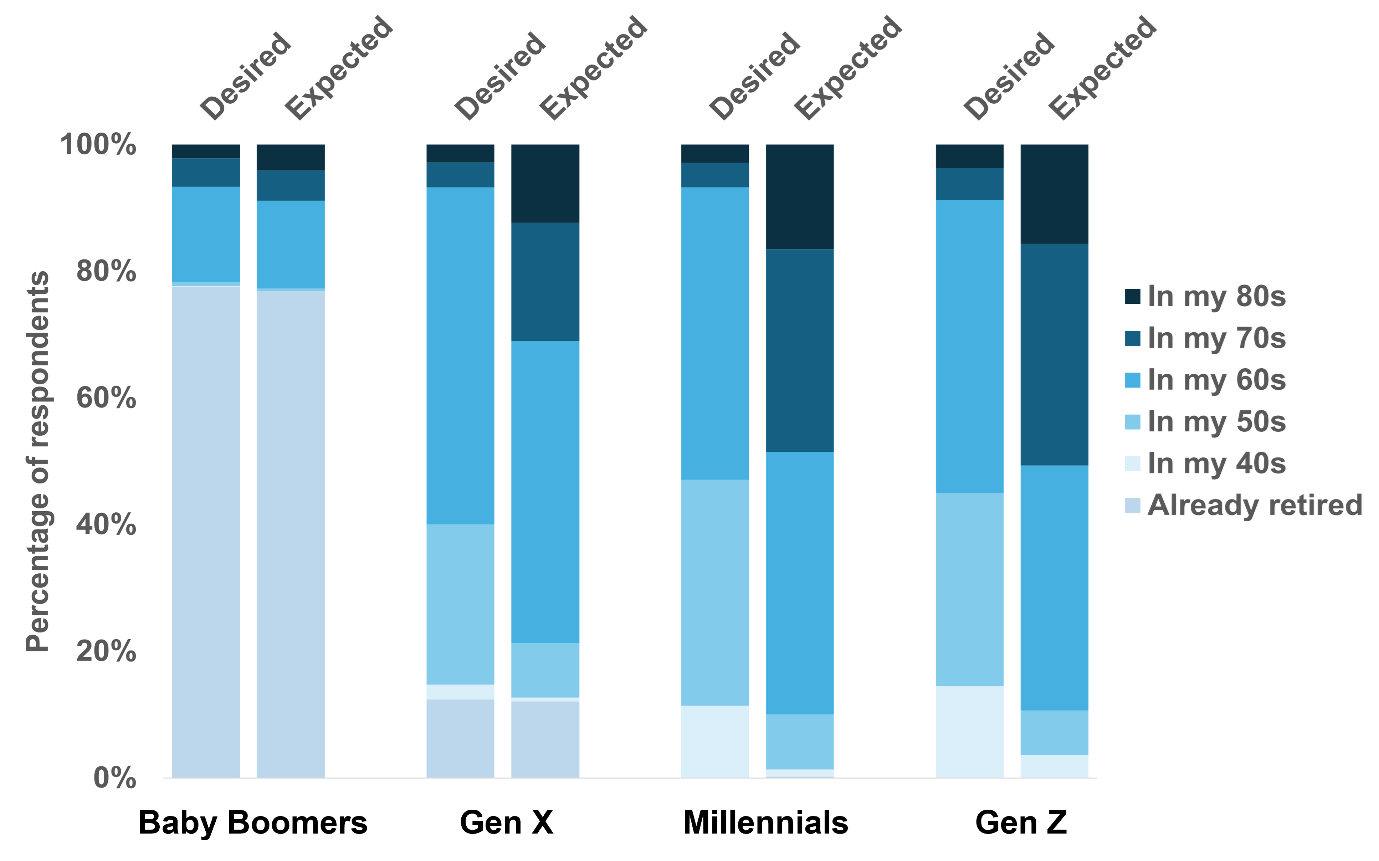
Not everyone retires at the State Pension Age. Some retire earlier using private pensions, while others continue working after claiming their state pension. But the most important finding from our research is the gap between when people would like to retire and when they expect to retire.
Figure 2 shows that this gap is largest among younger generations.
Figure 2. “At what age do you WANT to stop working and retire?”
Source: Authors’ calculations.
Generations and their ages
| Year born | Age in 2026 | |
| Baby Boomers | ~1946–1964 | ~62–80 |
| Gen X | ~1965–1980 | ~45–61 |
| Millennials | ~1981–1996 | ~29–44 |
| Gen Z | ~1997–2012 | ~14–28 |
Many Gen Z and Millennial respondents would prefer to retire in their 50s or 60s. But a large share expect that they will still be working into their 70s or beyond. In other words, younger people expect to work longer than they would like.
We also know that people revise their expectations over time. Those closer to retirement are less likely to expect to work beyond the State Pension Age. 4 Earlier expectations are not always borne out in practice, as people adjust their plans in response to changing circumstances.3
Even so, expectations remain important. They influence how people save, how they plan, and how they think about their future.
A growing gap between expectations and reality
Younger generations appear to have realistic expectations about longer working lives. The challenge is ensuring that people can afford to stop working when they need to.
While some may choose to work longer to remain active, many are likely to be compelled to do so by financial insecurity and insufficient savings. The growing gap between when people would like to retire and when they expect to retire points to underlying concerns about affordability and security in later life.
This raises important questions for pension policy. How can the system support people to retire with dignity and financial stability? And why do younger people aspire to retire earlier than their parents, even as they anticipate working longer?
Understanding this gap — between expectations and preferences — will be crucial for designing a pension system that works for future generations.
Endnotes
1 Mayhew, V. (2003). Pensions 2002: Public attitudes to pensions and saving for retirement: Research Report No. 193. Department for Work and Pensions.
2 Crawford, R., Cribb, J., Emmerson, C., & Simpson, P. (2020). Retirement expectations, attitudes and saving behaviour: how have these changed during a decade of pension reforms? Institute for Fiscal Studies
3 Ward, S. (2007). Women’s knowledge of, and attitudes to, pensions. In W. Loretto, S. Vickerstaff, & P. White (Eds), The future for older workers: New perspectives (pp. 89–102). Bristol University Press.
Authors
Lavinia Mitton is a Senior Lecturer in Social Policy at the University of Kent and researches income and welfare benefits.
Olena Nizalova is a Reader in Economics at the University of Kent and researches health economics.
Data source
A survey (N=3,365) of adults aged over 18 in England, Wales and Scotland commissioned by the University of Kent and carried out by YouGov in January 2026. Results were weighted to be representative of the general population. The results show meaningful generational differences.
DOI
TBC
Publisher
Care and Outcomes Research Centre (COReC), University of Kent
Suggested citation
Mitton, L., and Nizalova, O. (2026). Younger Brits want to retire in their 50s or 60s — but expect to work into their 70s [Research Summary]. Care and Outcomes Research Centre (COReC), University of Kent.
Grant
Connecting pensions, health and care: new research for an ageing population
The project has been funded by the Nuffield Foundation, but the views expressed are those of the authors and not necessarily the Foundation. Visit www.nuffieldfoundation.org