
The Advances in Qualitative Research (AQR) Seminar Series is an initiative of the Collaborative Solutions for Social Problems Lab bringing together early-, mid-, and senior-career researchers to deepen understanding of qualitative methodology in theory and practice.
Join the AQR Seminar Series
To subscribe and the online seminar link, email: aqr-phd-request@lists.kent.ac.uk
We have a regular programme of seminars with internal and external speakers.
Autumn 2026: AQR Special Focus Track on Diary Methods
Explore the full programme on Diary Methods
Next seminar: 28 October 2026
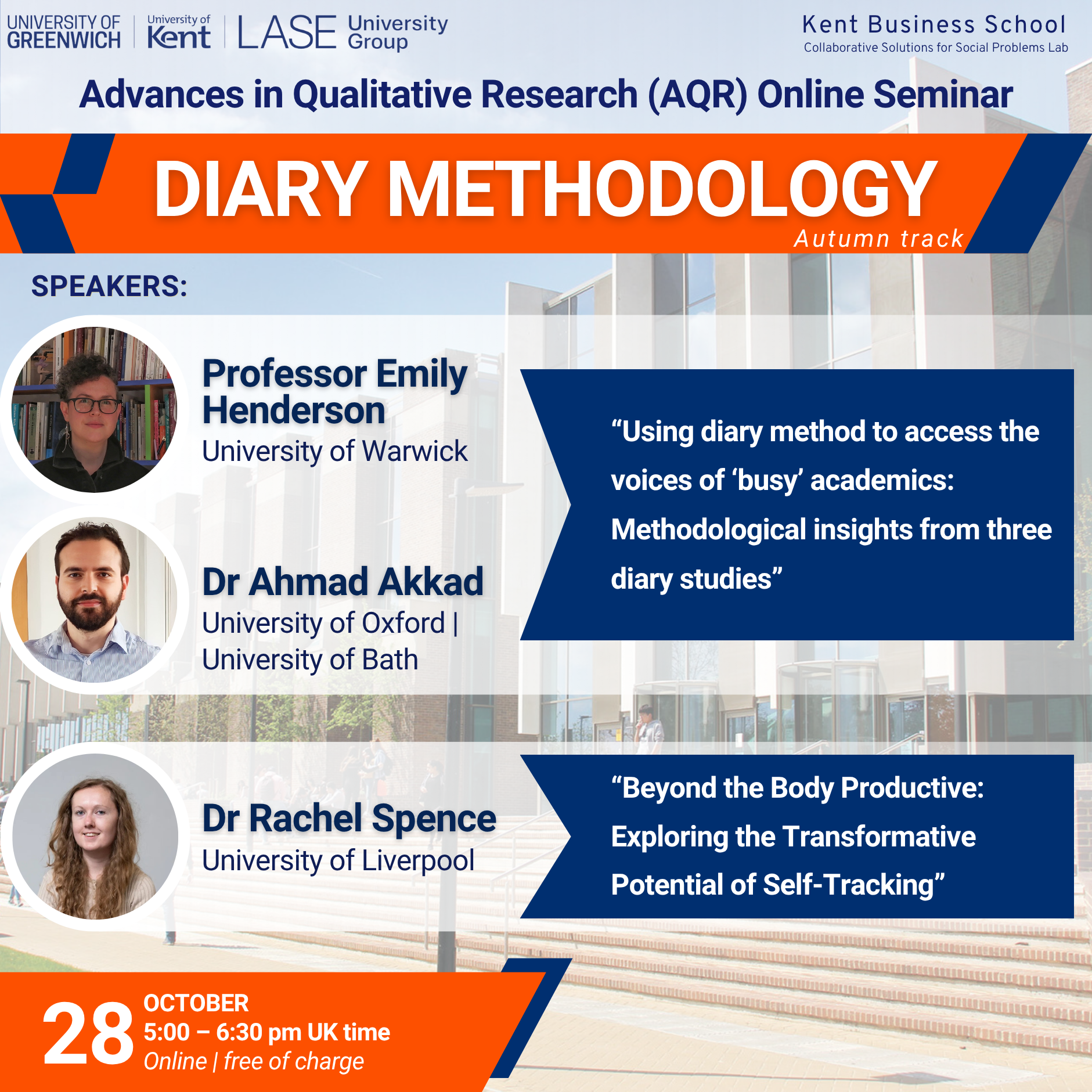
We are excited to welcome Professor Emily F. Henderson, Dr Ahmad Akkad and Dr Rachel Spence to share methodological insights from their diary studies. Drawing on their research, including work published in the leading journals Qualitative Research and Sociology, our speakers will discuss the choices and practical experiences involved in designing and using diary methods.
AQR Seminar Series Guidance:
The aim of the online seminars series is to bring together early, mid and senior career researchers, including Masters and PhD students, interested in Social Science Qualitative Research to improve their qualitative research understanding both in theory and in praxis i.e. applying it to their own research.
Two seminars per term (90 minutes per seminar) focusing on qualitative methods; one or two presentations per seminar, each not exceeding 20 minutes presenting leading published seminal journal papers followed by 20-minute discussion. All participants are expected to read the papers in advance and actively participate by providing comments/questions and share verbally a potential application of the paper in their research context extending our collective qualitative research ‘know how’. PhD students are encouraged to present their own early empirical qualitative findings and receive feedback by the AQR Community.
The AQR Seminar Series is an initiative of the ‘Collaborative Solutions for Social Problems’ Lab at the University of Kent, Kent Business School that was founded by Dr M. May Seitanidi focusing on the development of advanced solutions to social and environmental problems such as social inclusion, biodiversity, suicide prevention in industries such as construction, banking, food manufacturing and education. Empirical findings of such solutions employ qualitative methods which is a significant strength that is cultivated by our community and important for the next generation of collaborative solutions scholars.
For more information, please contact the AQR Seminar Series Co-ordinators, Maxim Potepkin (mp833@kent.ac.uk) and Isabeau Schmidt (is377@kent.ac.uk).
Participant testimonials
Attending the presentation by Somi Tarominejadshirazi on ‘Using tables to enhance trustworthiness in qualitative research, by Charlotte Cloutier & Davide Ravasi’ the presenter -Somi, unpacked it in a more clever, deeper yet easier way than I did when I read the paper. Stepping aside and allowing myself to understand the paper through the eyes of Somi was incredible and it made a difference. As a result, I was able to restructure my data analysis in a more systematic approach than I had done before I attended the seminar. And, it got the attention of my supervisors! To quote one of my supervisors, ‘This is a much more clear way that helps us understand the steps you have taken in your analysis that helped you arrive at the themes you are reporting in your findings’.
Lucy Muthoni Mbwiria
PhD Candidate, Kent Business School, 2024
Taking part in the AQR seminars helped me with my current research projects. First, familiarising myself with K. Eisenhard’s ideas made me cognizant of the fact that in one of my projects I should probably avoid using the umbrella term ‘Case study’ just as a ‘space-filler’ in the methodology chapter that seems to lack precision in the exact way data analysis is being approached. Second, presenting my finished piece of research with Critical Discourse Analysis made me rethink some of the methodological issues and get a deeper appreciation of its flexibility. Hence, as a result, I managed to generate a few novel ideas of how I might utilise CDA in my future research.
Sergei Shandrenko
MA Linguistics, qualitative researcher, 2025
Having participated in the AQR Seminar Series since 2023, I consider it one of the most valuable spaces for my development as an early career researcher. The sessions, built around carefully selected papers published in leading journals, offer important methodological and theoretical insights, enriched by in-depth discussions with participants from multiple countries, institutions and career stages. Above all, I value the opportunity to ask questions openly and receive thoughtful responses that speak directly to my own research challenges, while also enabling knowledge exchange with peers and leading academics. Even as my current research has developed in a primarily quantitative direction, my engagement with qualitative methods through the series has helped me reflect more carefully on the boundaries of my research at earlier stages and make a more informed decision about its methodological direction.
Maryam Ajaj
PhD Candidate, Kent Business School, 2026
The AQR Special Focus Tracks
The AQR Focus Track: Systematic Literature Review
- 18 March 2026
Professor Corinne Post, Fred J. Springer Endowed Chair in Business Leadership; Professor of Management, Villanova School of Business
How a Literature Review Can Change the Scholarly Conversation (Advancing theory with review articles)
- 27 May 2026
Maxim Potepkin, PhD candidate, KBS
A Process Perspective on Failure of Sustainable Business Model Innovation: Qualitative Meta-analysis
The AQR Focus Track: Historical Methods in Business and Management Research
The AQR Track was aligned with the British Academy of Management (BAM) Special Interest Group on Management and Business History.
- 22 October 2025
Prof. Stephanie Decker, Professor of Strategy, University of Birmingham
The Use of Digital Sources and Archives in Business and Management Research. - 22 October 2025
Dr Kerryn Krige, Senior Lecturer in Practice, Marshall Institute, London School of Economics
Reflections on Using the Charles Booth Archives to Teach and Research Social Entrepreneurship: Challenging the Positivist Narrative - 19 November 2025
Dr Steven Parker, Lecturer in Management, Open University
Bringing microhistory into public policy – the destruction of the lilypad fountain (Original study)
- 19 November 2025
Somayeh Tarominejadshirazi, Doctoral Candidate, Kent Business School
Organisational Sensemaking of Responsibility for Student Mental Health and Suicide Prevention in a UK University: A Textual Analysis of Publicly Available Communications (Original study)