Centre for Critical International Law
Featured story
CeCIL Annual Programme 2025-2026
11 November 2025 – A joint event between CeCIL and student societies (Kent’s Human Rights Law Society and International Law Society) aimed at exploring the contemporary limits of international law amid growing backlash against women’s rights and gender equality.
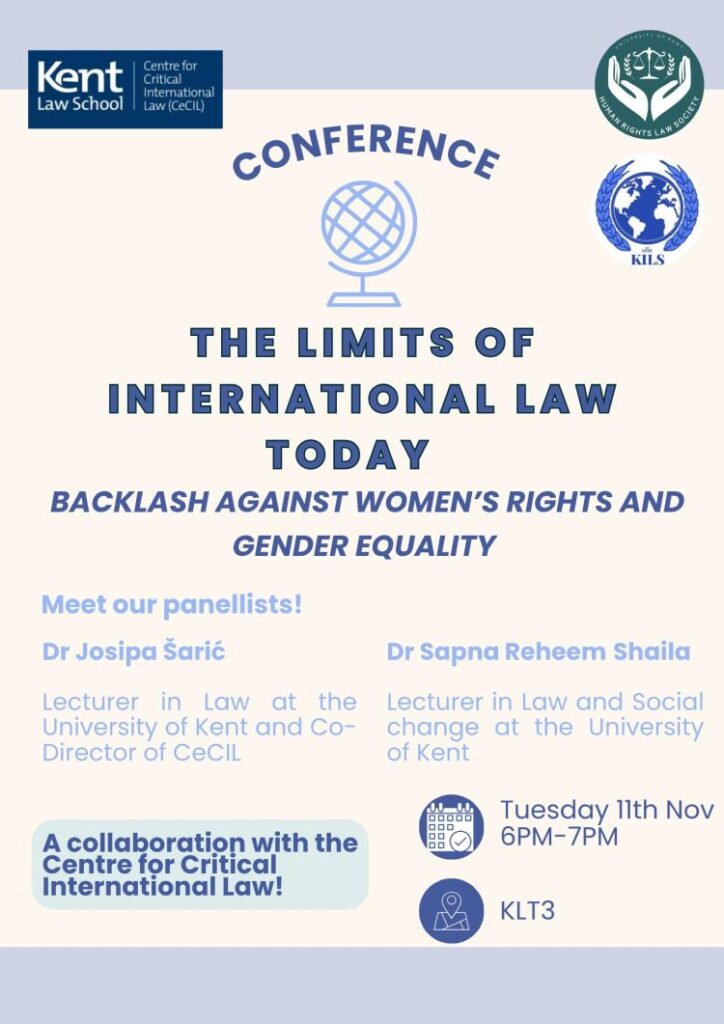
Led by Dr Sapna Reheem Shaila and Dr Josipa Šarić, the panel draws on their own research to explore legal frameworks protecting women’s rights and the tensions between states, societies, and international norms. Discussion with students looked at what the meaning of solidarity and diversity means in this context.
18 February 2026 – A dedicated meeting bringing together CeCIL members to reflect on the Centre’s activities, identify priorities, and discuss future directions. The forum provided a collaborative space for members to share ideas, aspirations, and suggestions for strengthening the Centre’s research culture, events programme, and strategic development. The discussion focused on fostering a stronger sense of community, encouraging member-led initiatives, and ensuring that members feel invested in the Centre’s future.
24 February & 3 March 2026 – A joint event between CeCIL and SeRGJ of screening and discussion of the BBC documentary Small Town, Big Riots, which examines the role of online misinformation and local tensions in community conflict. The event aimed to facilitate critical reflection on the impact of disinformation, digital communication, and social division, with particular resonance considering recent local events in Faversham and Canterbury.
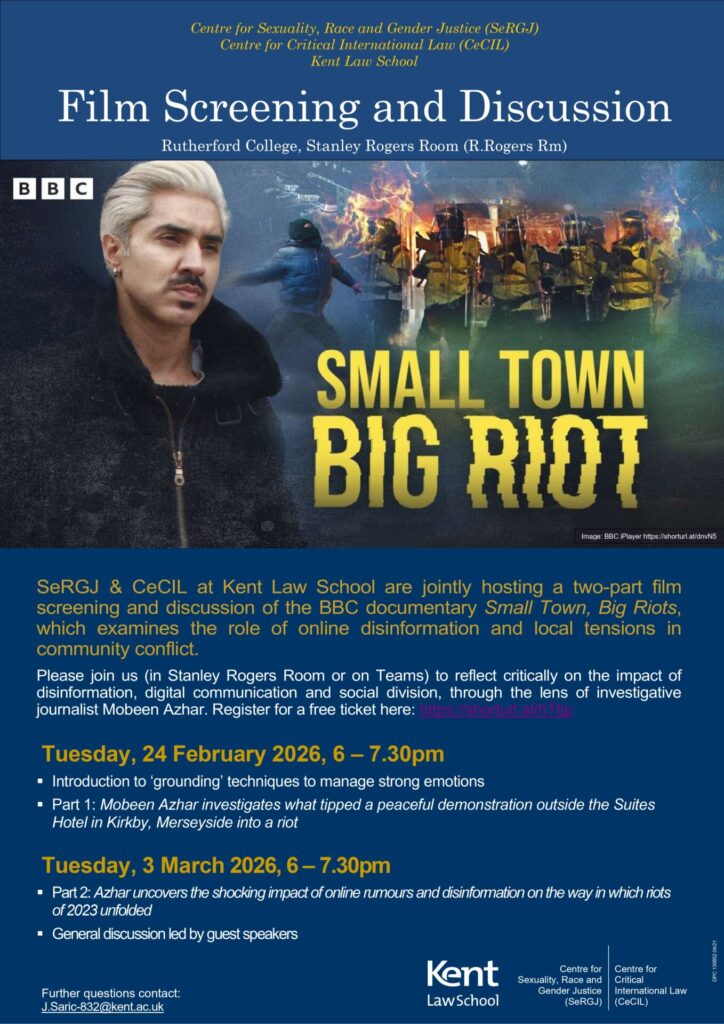
The screening took place across two sessions (each covering one part of the documentary), followed by an open and respectful discussion incorporating principles of emotional grounding and reflective dialogue. The first day, Hamsa Jayanathan, KLS LLM alumna, led an exercise on ‘grounding’ techniques to manage strong emotions. The second day, a general discussion was led by Guest Speakers: Dr Will Mbioh, Senior Lecturer in Law and Daniel Esson, Local Democracy Reporter for KentOnline and Kent alumnus. Both students and staff attended the event.
3 June 2026 – A collaborative research workshop designed to foster intellectual exchange and strengthen the Centre’s research community. Participants submit a short “fragment” of their work in advance, which may include written text, visual material, creative outputs, or other forms of scholarly expression. Participants were paired and invited to present their partner’s work rather than their own. Discussions focused on identifying and celebrating the intervention, contribution, and potential of each fragment, encouraging cross-disciplinary dialogue in a supportive and informal environment.
CeCIL Annual Programme 2024-2025
6 November 2025 – SeRGJ & CeCIL Film screening to celebrate the life and work of James Baldwin
SeRGJ and CeCIL co-organised film night with a special screening and discussion of Raoul Peck’s award-winning 2016 documentary I am not Your Negro, an adaption of Baldwin’s unfinished manuscript, Remember this House. Screening is followed by a discussion led by Dr Suhraiya Jivraj (SeRGJ co-director) and Guevara Leacock (Kent).
12 November 2024 – A joint Kent International Law Society and Centre for Critical International Law (CeCIL) panel discussion to discuss the escalating and expanding scope of the violence associated with the Israeli occupation of Palestine both within and beyond Gaza and the West Bank.
panellists:
Dr Shahd Hammouri (lecturer, KLS)
Dr Eric Loefflad (lecturer, KLS)
Dr Rose Parfitt (senior lecturer, KLS; co-director, CeCIL)
Abdelghany Sayed (doctoral researcher, KLS)
chair:
Yashwini Lokee (LL.B student, KLS; president, Kent International Law Society)
Following the panel, the event will move to K Bar to celebrate the rich heritage of musical traditions from Egypt & the Levant with London-based traditional Arabic music trio, Three Cards (on Instagram: ghany.3 and ziadhisham3; at the 2024 London Jazz Festival, 15 November: details here).
musicians:
Ziad Hisham (percussion)
Layla Sami (voice)
Abdelghany Sayed (oud)
2 December 2024 – A joint CeCIL and SeRGJ film and discussion event.
Questions of gender, race and, of course, international law play a crucial role in determining who lives and who dies while crossing—as well as who is identified after death—making this a central issue both for . The co-hosted film night is dedicated to thinking these questions through in the light of two documentaries: Even After Death (2020), directed by Said Reza Adib and Douglas F. Herman (55 mins); and the multi-award winning short film, Xenos (2014), directed by Mahdi Fleifel (13 mins).
Discussants:
- Dr Noemi Magugliani (migration and modern slavery research lead at the British Institute of International and Comparative Law and co-founder of de:border // migration justice collective)
- Dr Valentina Azarova (transformative justice practitioner and co-founder of de:border // migration justice collective and the emergent justice collective)
- Dr Álvaro Ramírez March (postdoctoral research fellow in critical social psychology at the Universitat Oberta de Catalunya)
28 January 2025 – CeCIL‘s Lunchtime Mingle will provide CeCIL members with the opportunity to engage in short conversations and share your research interests in an informal setting.
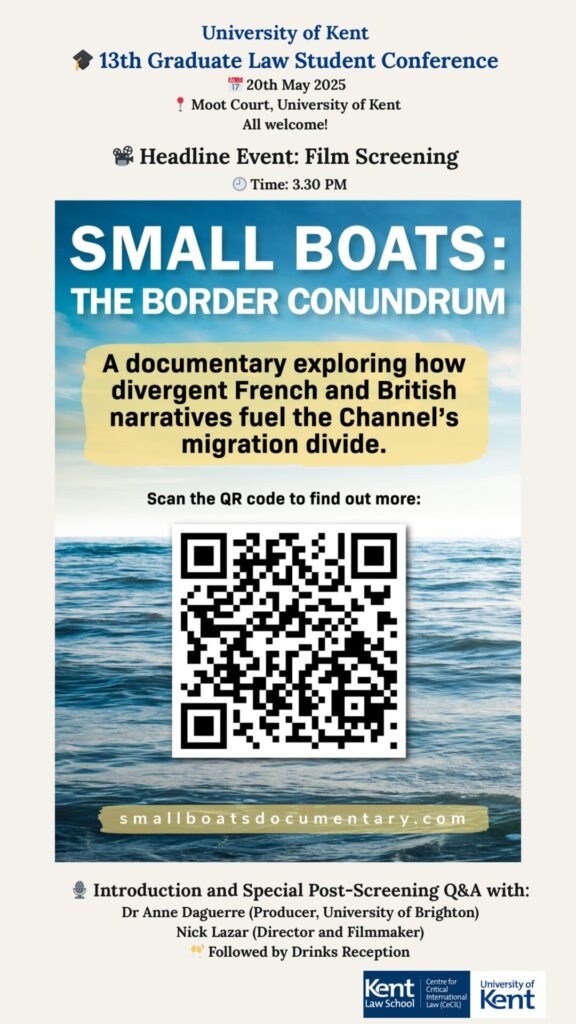
20 May 2025 – Co-organised with KLS LLM Student Conference.
Screening of the documentary ‘Small Boats: The Border Conundrum’, which will be introduced by Dr Anne Daguerre (Producer, Uni Brighton) and Nick Lazar (Director and Filmmaker) and followed by a special post-screening Q&A discussion. The documentary explores how the divergent French and British narratives fuel the Channel’s migration divide. You can learn more about the documentary here: https://smallboatsdocumentary.com/.
CeCIL Annual Programme 2023-2024
3 October 2023
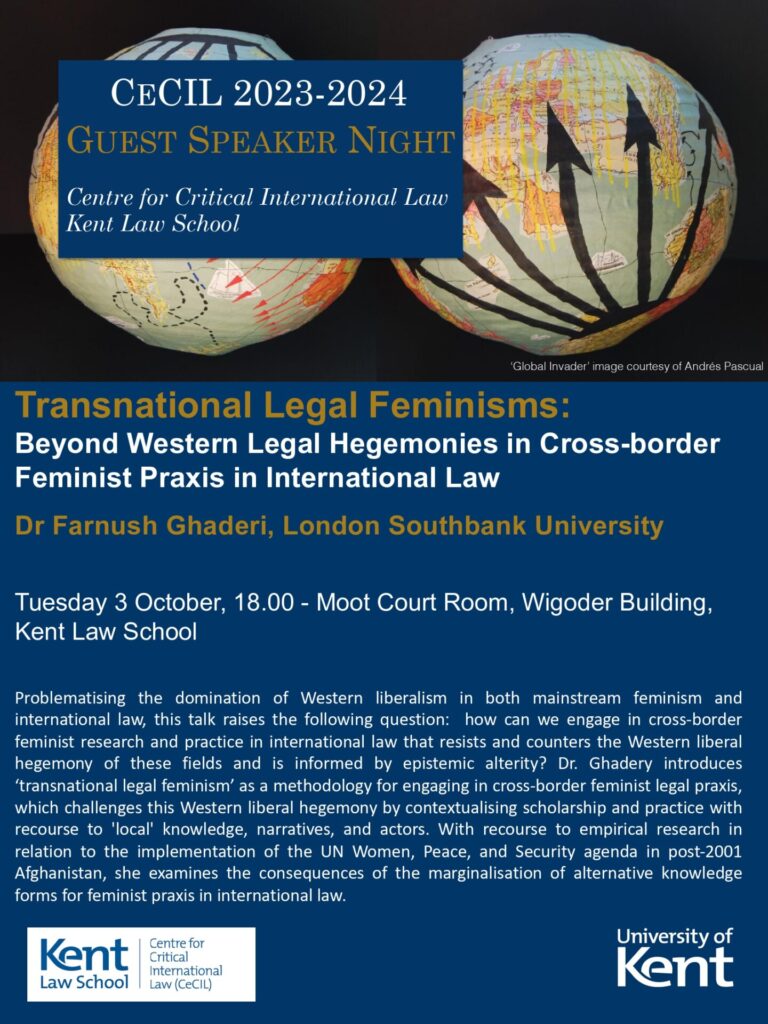
16 October 2023 – Joint SeRGJ / SoCriL / CeCIL Event
Professor Ntina Tzouvala (ANU College of Law) will be talking about The “unwilling or unable” doctrine and the political economy of the war on terror
The ‘unwilling or unable’ doctrine is amongst the most contested in contemporary international law. However, in this talk, I am not concerned with whether the doctrine accurately reflects the international law of self-defence and force. Rather, drawing from critical security studies, especially those strands that study the relationship between the war on terror, and capitalist accumulation, and critical political economy this paper examines the forms of political economy and statehood implicit in the doctrine. I will argue two things: first, the doctrine envisages a gradated form of sovereignty dedicated to the reproduction of racial capitalism. Secondly, the doctrine incorporates the imperatives of financial capitalism insofar as it seeks to guarantee ongoing demand for military services and equipment into the future.
7 November 2023 – Dr Kathryn Greenman from UTS, Sydney, will be speaking to ‘International Organisations and the Risk Managment of Conflict’. Kathryn‘s research explores the interrelation between the economic and the humanitarian in international law.
Abstract: International Organisations and the Risk Management of Conflict
It is commonly claimed in international policy and scholarship that there is something new about contemporary wars that makes them uniquely difficult to resolve.1 In response, international organisations such as the United Nations, the World Bank, the OECD and the European Union have proposed a new approach to conflict centred around early and sustained engagement, managing the risk of potential future conflicts rather than responding to actual conflicts, and building the resilience of vulnerable communities. This paper will attempt to think through the potential political and economic implications of this reframing of armed conflict as an ahistorical and technical risk to be managed.
Drawing on Obiora Okafor’s work on asserting newness as a political practice that seeks to justify (otherwise untenable) international legal reform,2 this paper will argue that claims that the nature of contemporary protracted conflicts is unprecedented are in effect normative rather than descriptive. I will argue that the project that such claims found is one that proposes a profound expansion of the role and authority of international, especially financial, institutions and promotes market-friendly solutions to conflict that extend the role of private corporations and management experts in the Global South.
16 November 2023 – Co-hosted with the Centre for Cultural Heritage and KLS Research Seminar series.
Professor Lukas Lixinski, University of New South Wales, Sydney, is an expert in international cultural heritage law and international human rights law. In this talk, Lucas Lixinski covers issues around the return of cultural artefacts to once-colonized territories and communities. Examining the Portuguese practice in relation to its former colonies in Africa, he asks questions about law’s relationship to the past, present, and future. The Portuguese context helps unpack how traditional legal binaries – public and private, licit and illicit, legal and non-legal – frame and are reframed in our (re)negotiation of the past. The talk will expose how different legal methods invite different questions of the same legal situation, and what they mean for the basic assumptions about the law we often take for granted.
21 November 2023 – A panel discussion with Dr Tom Frost, Dr Suhraiya Jivraj and
Dr Rose Parfitt of KLS on international law, colonialism, empire and their legacies.
23 January 2024 – A panel discussion with Dr Alex Damianos and Dr Andreas Kotsakis, who will be discussing their approaches to law and the natural world.
CeCIL Annual Programme 2022-2023
18 October 2022 – ‘Critical International Law Conversations’ a panel discussion in which colleagues discuss their research and pedagogy. Dr Benjamin Thorne, Dr Marina Velickovic and Dr Mwangi Wanjiru will be in conversation and reflect on their work and what they find exciting about teaching and researching international law at Kent. It’s also an opportunity to learn more about the importance of research-led teaching at KLS and the innovative work that colleagues are doing.
15 November 2022
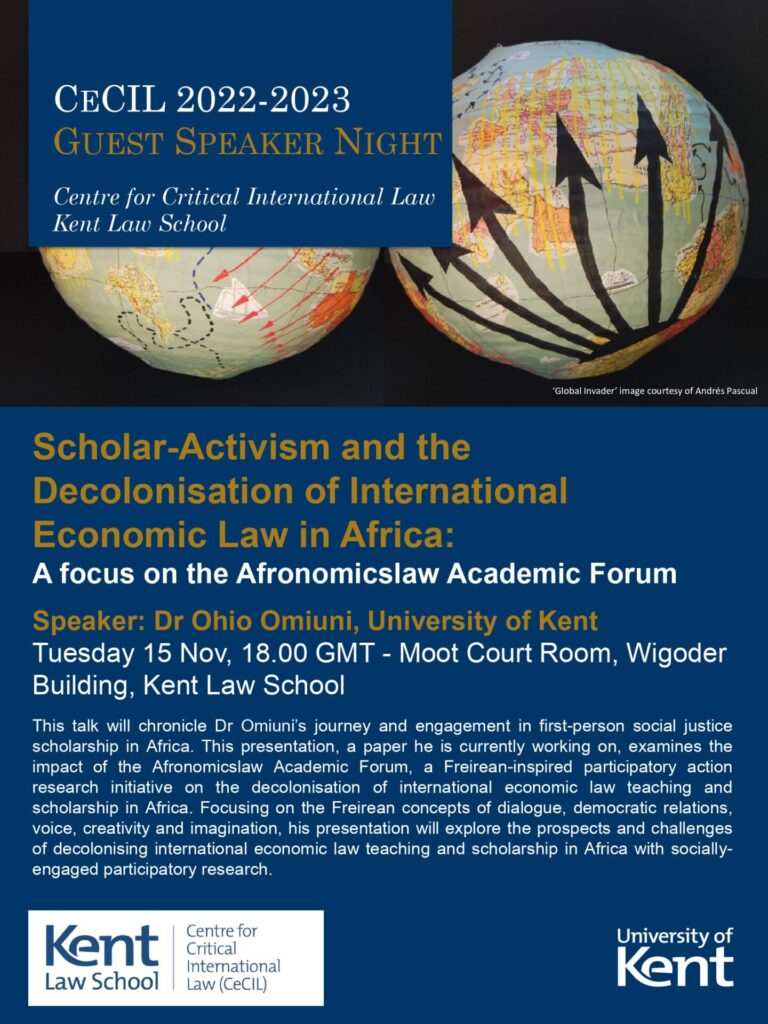
20 February 2023
Working Title:
‘Infinite Mistranslation: The Finno-Ugric Languages and the Generative Poverty of International Legal Rhetoric in a World of Empires’
Abstract:
Amongst critical international lawyers, there is no shortage of debate on whether linguistic structure or materiality should be the touchstone for analysing international law’s worldly effects. In offering something of a synthesis, this paper explores the materiality of a particular manifestation of language politics that had, and continues to have, vast, yet profoundly under-theorised, implications for the development of international legal thought. Here I focus on the Finno-Ugric linguistic identity projects that ultimately resulted in the majority speaker sovereign states of Hungary, Finland, and Estonia, as well their relationship to Finno-Ugric speakers who remain minorities within larger constitutional orders. Outside the dominant Indo-European language family that otherwise united Europe and connected it to an array of ancient civilisations, for Finno-Ugric peoples under various regimes of imperial rule by Scandinavian, German, and Russian speakers, their simultaneous inclusion-exclusion as Europeans led to unique assertions of collective identity and kinship bonds – often defying reigning logics of ‘standard of civilisation’ by claiming affinity with Eastern societies far removed from the European racial/cultural ideal. Such assertions raised profound questions of international law and the ways in which it structured, and was structured by, the questions of nationhood, empire, and ‘civilisation’ that defined the birth of the modern global system. Given their linguistic otherness (a difference believed to have great bearing on culture), Finno-Ugric speakers were uniquely equipped to be sceptical of definitive meaning in international legal language – the end sought by legal formalists. Simultaneously, familiarity with European culture allowed Hungarians, Finns, and Estonians to strategically mobilise the definitional shortcomings of international legal concepts when navigating their liminal positions within imperial hierarchies functioning within a greater inter-imperial world-system. Linking together varied engagements by Finno-Ugric speakers from the early middles ages to the ongoing Russia-Ukraine War, this paper builds an overarching narrative on how a distinct, yet connected, array of linguistic insider-outsiders has occupied, and continue to occupy, a unique position when expanding our consciousness of international law as a worldly force.
7 March 2023
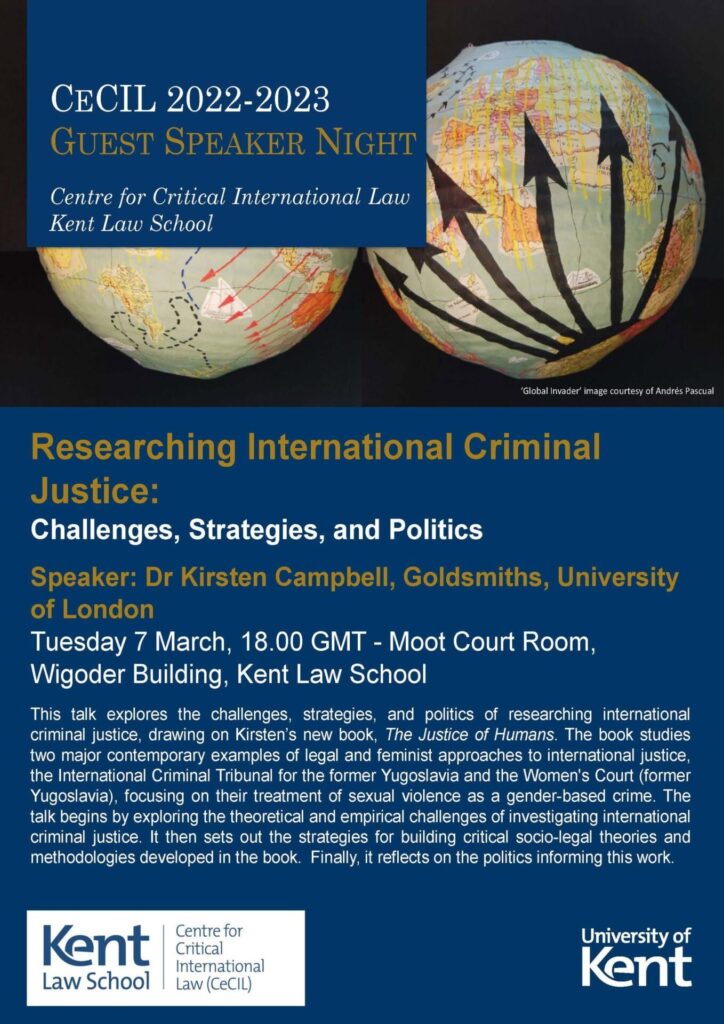
13 March 2023
Working Title: ‘Victimhood and Hierarchies: on the role of gender and nationalism in transformative reparations’
Abstract
Since the adoption of United Nations Security Council Resolution 1325, academic and policy inquiries have continuously called for more inclusive approaches to the design of reparation programmes, for instance involving grassroots women’s and victims’ groups. The hope has been that by taking an inclusive approach, reparation programmes would become more gender-just and have a transformative impact on the lives of the survivors and on society as a whole. However, including grassroots women’s and victims’ groups in the design of reparation programmes with the aim of producing society-wide transformative change can be challenging in societies recovering from conflicts where national identities played a central role. In these cases, tensions fuelled by nationalist discourse may continue to manifest decades after the conflicts have ended. This is particularly evident in the case of Croatia, where these tensions have the ability to influence discussions on reconciliation or restorative justice.
This paper explores the interplay between gender and nationalism as it unfolds in the representation of victimhood during the drafting of Croatia’s reparation law for victims of wartime sexual violence. It does this by examining how the Association of Women in the Homeland War, a Croatian non-feminist women’s group, campaigned for gender-just reparations using nationalist rhetoric. Based on an analysis of the Association’s discourse from 2011 to 2015, the paper explores the changing shape of The Victim as it progresses throughout the legislative process. As it moves from being Silenced, to Sacrificial and ultimately becoming Compensable, The Victim challenges some gender hierarchies whilst reinforcing existing (ethno)nationalist hierarchies. This localised construction of victimhood offers a new perspective through which to understand gender-just reparations and their transformative potential.
23 March 2023