(Guest post by Parmida Abdollahi, Stage 4 Physics student)
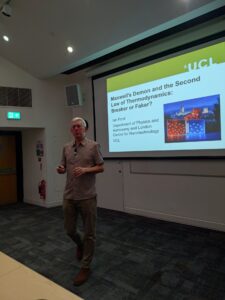
Professor Ian Ford, from University College London, gave the first talk in this academic year’s lecture series with an audience of 35 people, on how Maxwell designed a thought experiment featuring a fictional creature, Maxwell’s demon, to explore whether the second law of thermodynamics is absolute, or can be broken.
 The second law of thermodynamics stands as one of the most foundational rules in physics, stating that the total entropy of a closed system can never decrease over time. Entropy represents the uncertainty about the exact state of the world due to its complex dynamics. It is fundamentally about missing information, which makes entropy somewhat subjective, as one observer may possess more information about a system than another.
This concept ties directly into the arrow of time, which distinguishes the past from the future, which means that certain events are strictly irreversible. Once an event takes place, it cannot be undone, for example, once you blend fruit into a smoothie, you cannot reverse the process to get the whole fruits back. However, when we look at the universe through a classical 6D phase space, which tracks each particle by its 3 coordinates of position and 3 coordinates of momentum, the rules change. While we use macrostates to limit and categorize the configuration of the universe based on what we can perceive, a truly deterministic classical world implies that the trajectory of the universe is entirely set. This means that if we start with a small initial configuration, we inevitably evolve toward the largest possible microstate: entropy increases as time passes.
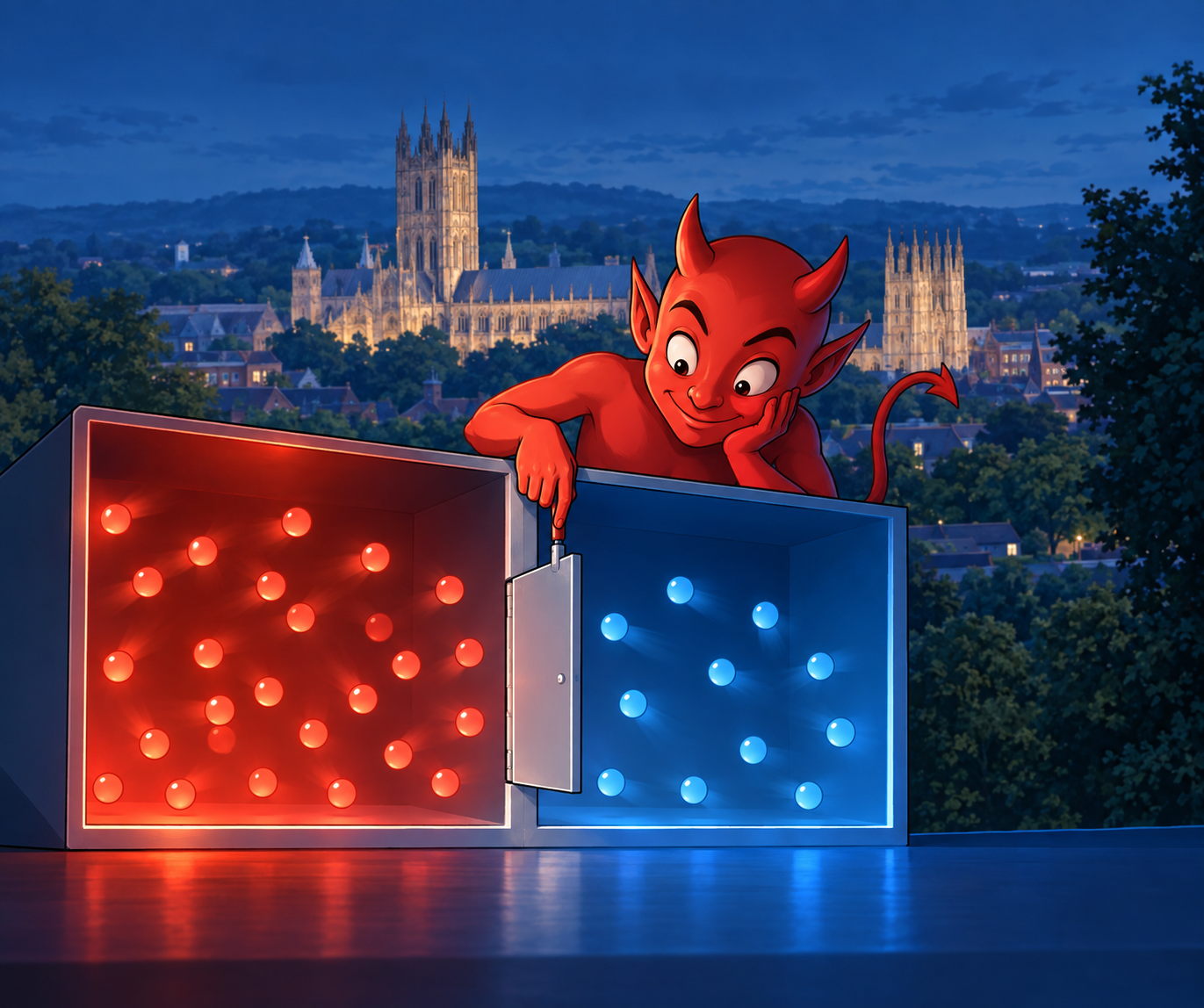
Here is where the Demon enters. The purpose of the demon is to challenge the second law of thermodynamics and to reduce the entropy of the universe as time goes by. Maxwell’s thought experiment introduces a microscopic demon controlling a door between two gas chambers connected by a vessel. The demon sorts gas molecules based on their speed. Fast molecules from the right chamber are allowed to pass to the left, and slow molecules from the left chamber are allowed to pass to the right. With no other movement permitted, the demon eventually separates the hot and cold (fast and slow) molecules. This reduces the system’s entropy because our uncertainty about the system drops, as we now know exactly where all the molecules are.
There are four scenarios and arguments for this demon actually breaking the second law of thermodynamics. The four scenarios are as follows, which we will examine to see whether the demon actually breaks the law, or it is in fact, a fake demon:
- The Erasure Cost (The “Forgetful” Demon)
In this scenario, the demon sorts the molecules one by one, but eventually runs out of memory and forgets the data. Erasing or destroying information inherently produces entropy. This memory wipe generates enough external entropy for the system to perfectly cancel out the earlier reduction of entropy achieved by sorting the gas. Fake demon!
- The Measurement Cost
Here, the act of acquiring information itself carries a thermodynamic price. Performing a measurement to see if a molecule is fast or slow costs entropy. Because of these hidden entropy costs, the second law remains secure, exposing the demon as a faker!
- Time-Reversal Asymmetric Dynamics
In a different type of universe governed by asymmetric dynamics, the demon opens the gate before measuring which type of molecule is passing. While this blind mechanism would successfully reverse the law, it is physically impossible in our reality – fake demon (in our universe)!
- The Loschmidt Trajectory
The final scenario involves a Loschmidt trajectory, where all particles in a system are simultaneously reversed in time and sent backward along their paths that got them to the present moment. This forces everything to happen in reverse without needing a measurement. While impossible for large systems, this time-reversed evolution is not impossible for tiny, microscopic systems. In these hyper-specific, microscopic instances, the demon acts as a legitimate law breaker, and violates the second law of thermodynamics!