Tuesday 14th April 2026, 6.30pm, Sibson Lecture Theatre 3
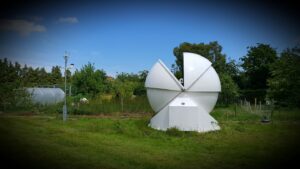 Dirk Froebrich (University of Kent)
Over the past few decades, astronomical telescopes have grown ever larger, with 8-metre giants now the dependable workhorses of modern observatories and 30-metre behemoths rising on mountaintops around the world. In this era of “extreme” astronomy, it is tempting to think that small telescopes — those with apertures under half a metre — have been left behind. In this talk, I will challenge that assumption. I will showcase how modest, often amateur-run telescopes have delivered powerful and sometimes unique insights into how stars and planets form. Over the past ten years, our work has used these small instruments to probe starspots on young, still-forming stars, trace subtle and evolving structures within accretion disks, and even uncover tantalising hints of protoplanets embedded within those disks. This is a story about precision over size, persistence over power, and how small telescopes continue to enable big science.
About the speaker
Dr Froebrich is a reader in Astronomy/Astrophysics, and member of the Centre for Astrophysics and Planetary Science (CAPS) at the University of Kent. His main research areas are young protostars and their outflows, structure and properties of molecular clouds and the formation and evolution of star clusters. He is the Director of the university’s Beacon Observatory, the lead of the citizen science project: Hunting Outbursting Young Stars (HOYS), and this years recipient of the Higher Education Award of the Royal Astronomical Society.
The talk is free and open to all. Doors open about half an hour before the talk begins.
Optional registration – if you wish to register, you can do so at the Institute of Physics web pages.
For directions to the lecture theatre, see here.