Module details

The module details panel is used to showcase different modules based on their ID.

Panel settings

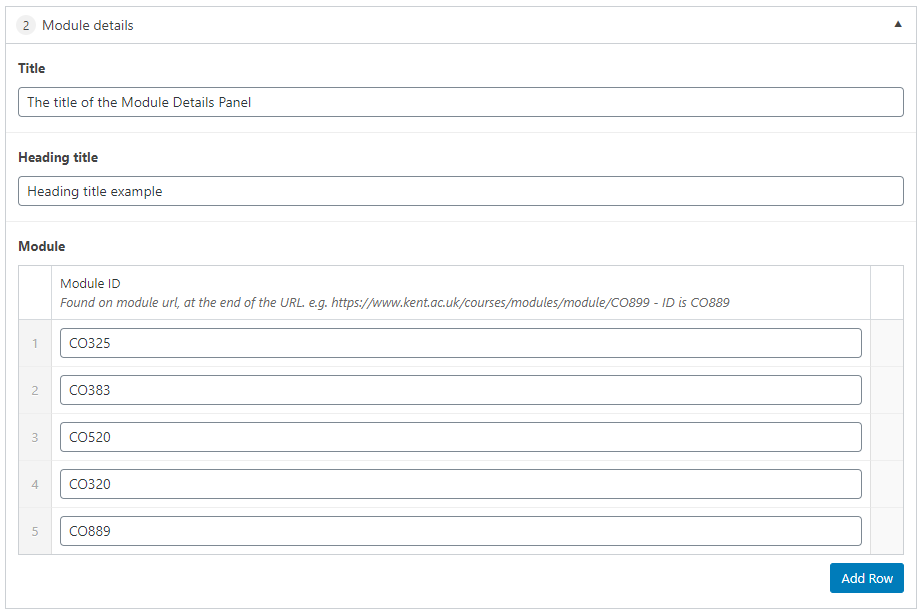
Module IDs follow the pattern of 2 letters and then 3 numbers such as CO832, the first two letters refer to the course and the 3 digits refer to the module number. The panel displays the same info as from https://www.kent.ac.uk/courses/modules.

  • Title – This is the title for the panel
  • Heading title – This is used on the header row of the table and forms the label for the modules column
  • Module – Add a row per module to be added. Enter the ID for each course, e.g. CO889

Example

The title of the Module Details Panel

Heading title example Credits

This module follows from COMP3220 and aims to provide students with more understanding of the theory behind the formal underpinnings of computing. It will build upon the abstract reasoning skills introduced in COMP3220. Matrices, vectors, differential calculus, probability and logic will be introduced.

View full module details
15

This module aims to strengthen the foundational programming-in-the-small abilities of students via a strong, practical, problem solving focus. Specific topics will include introductory algorithms, algorithm correctness, algorithm runtime, as well as big-O notation. Essential data structures and algorithmic programming skills will be covered, such as arrays, lists and trees, searching and sorting, recursion, and divide and conquer.

View full module details
15

This module builds on the foundation of object-oriented design and implementation found in CO320 to provide both a broader and a deeper understanding of and facility with object-oriented program design and implementation. Reinforcement of foundational material is through its use in both understanding and working with a range of fundamental data structures and algorithms. More advanced features of object-orientation, such as interface inheritance, abstract classes, nested classes, functional abstractions and exceptions are covered. These allow an application-level view of design and implementation to be explored. Throughout the course, the quality of application design and the need for a professional approach to software development is emphasised.

View full module details
15

This module provides an introduction to object-oriented software development. Software pervades many aspects of most professional fields and sciences, and an understanding of the development of software applications is useful as a basis for many disciplines. This module covers the development of simple software systems. Students will gain an understanding of the software development process, and learn to design and implement applications in a popular object-oriented programming language. Fundamentals of classes and objects are introduced and key features of class descriptions: constructors, methods and fields. Method implementation through assignment, selection control structures, iterative control structures and other statements is introduced. Collection objects are also covered and the availability of library classes as building blocks. Throughout the course, the quality of class design and the need for a professional approach to software development is emphasised and forms part of the assessment criteria.

View full module details
15