It has long been recognised that letters are a crucial source for understanding Britain’s early medieval past. They tell us about key historical developments and decisions; about social networks stretching to Ireland, Germany, Rome and Jerusalem; and they allow us to hear voices beyond male institutional elites, with a significant number written in the names of women and lay individuals. Despite this, the surviving epistolary corpus has received remarkably little consideration as a single body of literature. Our three-year project (2026-2028) represents the first-ever comprehensive assessment of this material. We are seeking to demonstrate the crucial – and often underappreciated – role that letter-writing had during this formative period of British history, as a means of connecting people, disseminating knowledge, traversing linguistic boundaries, and building networks and structures of power. We argue that without letters and their carriers, Britain’s early medieval history would have been very different.
Currently we know of approximately 500 surviving letters that were sent to, from or within Britain between the fifth and mid-eleventh centuries. This equates to less than one letter per year. Most only survive because they were copied into a medieval cartulary, letter-collection or narrative text. Such preservation represents exceptional acts, not routine aspects of epistolary activity. References to now-lost letters, and the sheer diversity of contexts represented by the extant corpus, suggest that much has been lost, most likely because letters often served immediate needs and were rarely cherished for future generations.
Our challenge is to reconstruct this letter-writing world. We believe that a far clearer and more nuanced understanding can be achieved, if we think critically about how surviving letters have been preserved; if we pay closer attention to the footprints of now-lost letters; and if we adopt a holistic approach to the evidence for letter-writing across Britain’s early medieval centuries, regions and languages. Our project takes up this challenge with a diachronic, cross-regional, interdisciplinary investigation.
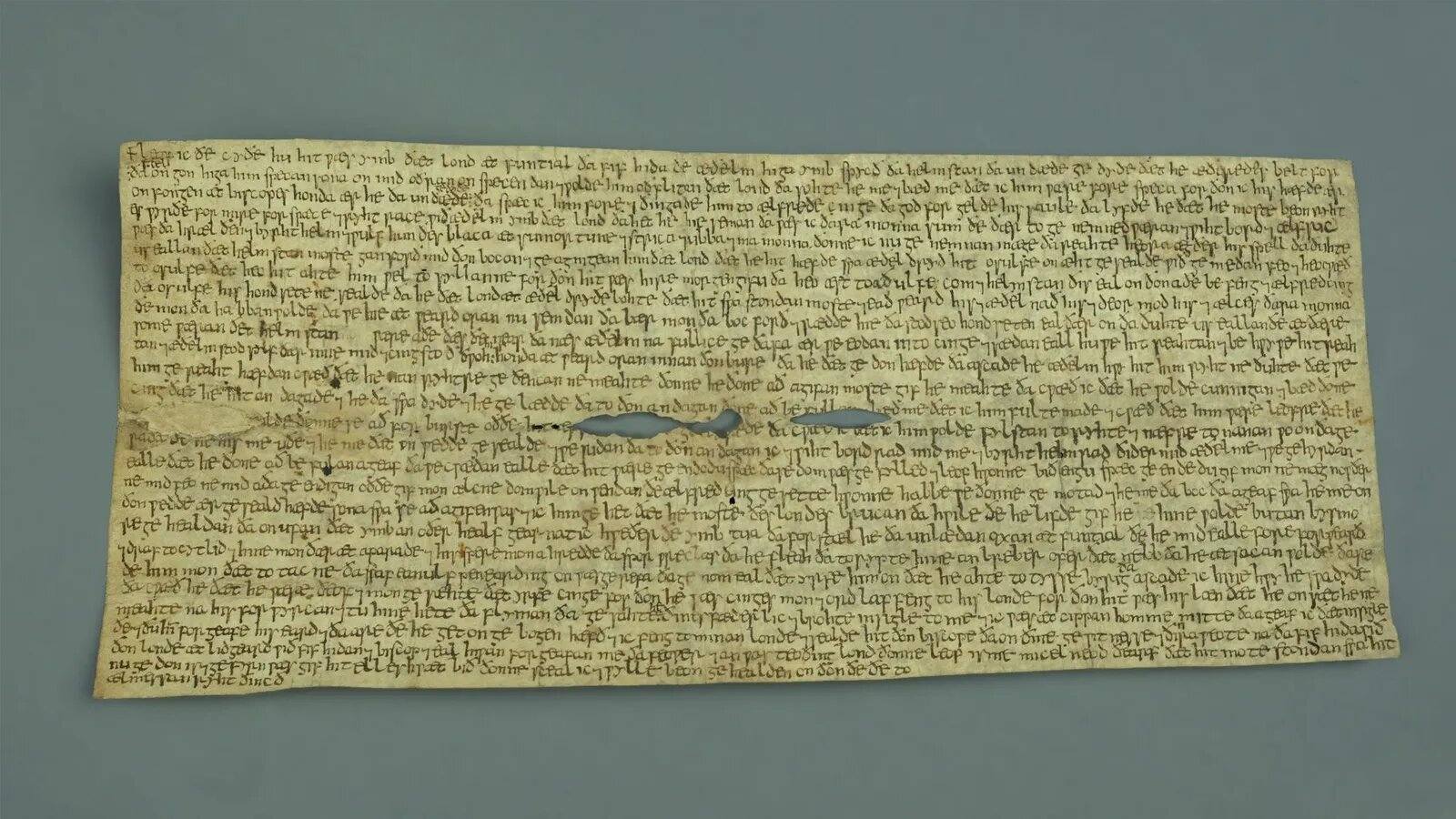
Banner image: The Fonthill letter (Canterbury Cathedral Archives, ChAnt/C/1282); reproduced with kind permission of Canterbury Cathedral)