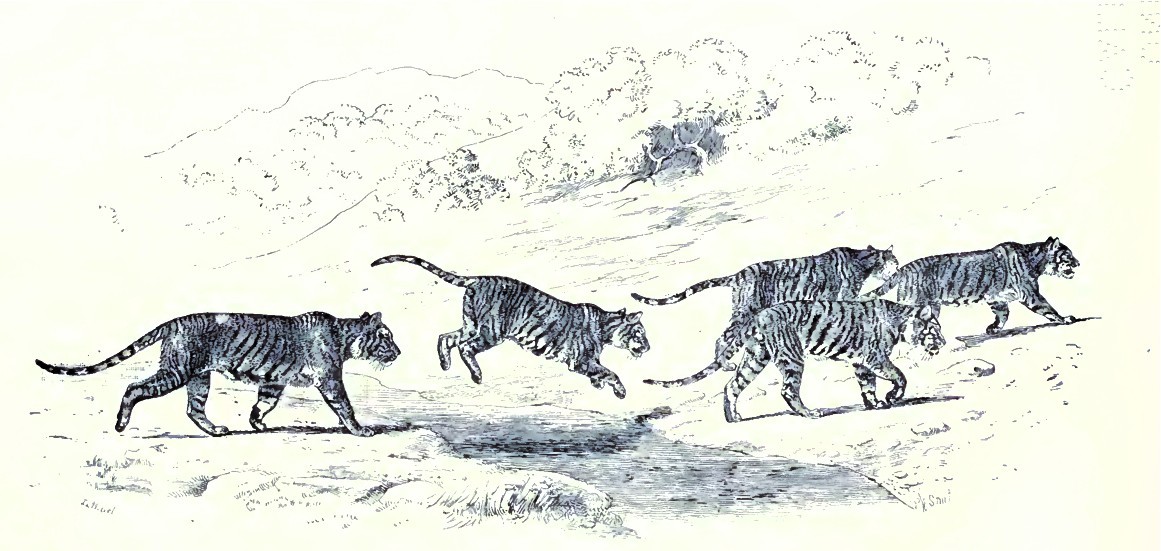
Image credit: George Douglas Hamilton, ‘What I saw one morning,’ Records of Sport in Southern India (1892)
We are live! ‘Tracking Wild Things in Time: Understanding the international wildlife trade through Conservation Humanities techniques (CHUMS)’ is an interdisciplinary project based at the University of Kent and generously funded by the Royal Society, the Royal Academy of Engineering and the British Academy’s APEX scheme. Over the next two years we will be exploring a number of species portfolios and liaising with national and international wildlife crime agencies to document a longer story of capture, manufacture and consumption beyond the commodity, using team expertise in biological science, literature, environmental history and legal-imperial studies. So exciting to kick this off and start thinking about our case study critters and how Conservation Humanities can make positive interventions in the realm of biodiversity protection, species advocacy and wildlife crime enforcement.
We are:
Prof Karen Jones, History/The Durrell Institute of Conservation and Ecology (DICE)
Dr Dave Roberts, DICE
Dr Kaori Nagai, English
Dr Claire Wrigley, History
We abuse land because we see it as a commodity belonging to us. When we see land as a community to which we belong, we may begin to use it with love and respect (Aldo Leopold).
The international trade in wild things (plants and animals) has become a subject of increasing political/social concern in the last 15 years. From pangolins to orchids, European eel to elephant ivory, highly-prized species have been targeted by a commodity market which is complex, relentless and (significantly) hard to trace. Various legislative and scientific interventions have sought to combat this trade, but arts and humanities approaches have played only a limited role in understanding it. ‘Tracking wild things in time’ changes all that, taking a leaf out of Aldo Leopold’s book to look ‘beyond’ the commodity and think about cultural values, stories and ecological communities. Blending historical/cultural expertise and conservation biology techniques, we document a ‘longer story’ of capture, manufacture and consumption to deliver critical insights on 5-10 target species. Why are they valued? Where do they come from? What products do they end up as? What are the principal threats to their survival in the right now? In this pilot study, our focus of attention is the British import/export market (one of the largest in the world), where we utilise the extensive connections of the team with national crime agencies & museum/advocacy/arts organisations to inspire new evaluations of wildlife ‘value,’ enhance enforcement work and raise public awareness of threatened species.