On this page
Research Projects for Prospective Research Students
Instrumentation Projects
CO2 Flow Metering under CCS Conditions Using Coriolis Mass Flowmeters and Soft Computing Techniques
Measurement of CO2 flow in the CCS chain is also a challenging and pressing problem with the recent development and deployment of the CCS scheme in many countries. CCS is considered as an effective technology to reduce CO2 emission from electrical power generation and other industrial processes. Accurate measurement of captured CO2 is necessary not only for environmental purposes to detect CO2 leakage, but also for verification of the CO2 account under emissions trading schemes. However, CO2 flow in the CCS chain is more difficult to measure than other multiphase flows as the physical properties and flow regimes of CO2 could change significantly through the long-distance transportation, especially with the variations of environmental temperature and pressure or in the presence of inevitable impurities. This project aims to apply Coriolis flowmeters incorporating soft-computing techniques to determine both flowrate and volume fraction of CO2 flow. Hybrid data-driven models and deep learning models will be developed based on experimental data. Meanwhile, the dynamic characteristics of CO2 flow under CCS conditions will be analysed.
Candidates should have, or are expecting to obtain in the near future, a First Class or good 2.1 Honours Degree in Electronic Engineering, Computer Science or a related discipline. An appropriate degree at Masters level will be an advantage.
Please contact Dr Lijuan Wang (L.Wang@kent.ac.uk) for more details.
Combustion Stability Monitoring through Deep Learning
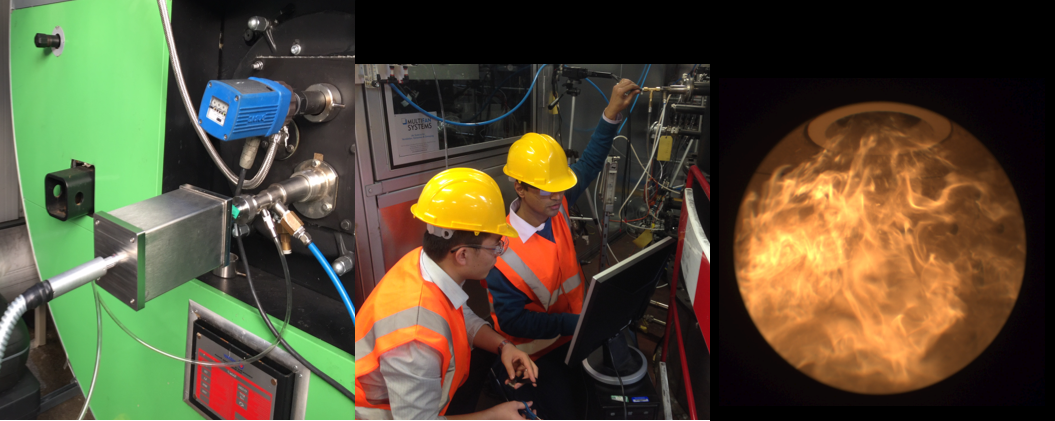
Various techniques are available for measuring flame parameters such as temperature, oscillation frequency etc. in combustion systems. The quantitative assessment of the flame quality (e.g., stability) can then be carried out based on the multiple parameters measured. However, there are still significant errors in the existing techniques due to the complex nature of the combustion process (e.g., multiple parameters). Deep learning technique is a powerful tool to identify the combustion instability and this would significantly advance the state-of-the-art in combustion diagnosis. This project aims to perform an intelligent combustion instability monitoring with the aid of digital imaging, image processing data analytics, and deep learning techniques. The objectives are to develop a prototype imaging system for acquiring flame videos under different combustion conditions; to develop a deep convolutional neural network (CNN) architecture and image processing techniques to process the flame videos; to develop a graphical user interface for real-time prediction of flame instability.
Candidates should have or are expecting to obtain in the near future, a First Class or good 2.1 Honours Degree in Electronic Engineering, Computer Science or a related discipline. An appropriate degree at Masters level will be an advantage.
Please contact Dr Md Moinul Hossain (m.hossain@kent.ac.uk) for more details.
Condition Monitoring of Wind Turbines through Multispectral Imaging
Onshore and offshore wind farms are becoming an increasingly important source of renewable energy and are used in many countries including the UK as part of a strategy to reduce their reliance on fossil fuels. As wind turbines are usually deployed in a harsh environment, it is necessary to monitor the operating state and structural health in an on-line continuous manner. Condition monitoring is an effective way to detect early faults and minimise unplanned maintenance and downtime. However, the current condition monitoring systems mostly focus on the detection of certain drivetrain components and lack of the monitoring of support structures of wind turbines. These single monitoring technique based systems usually have limited reliability and accuracy. In this case, a multifunctional and high-performance system is highly desirable. This project aims to develop a novel measurement system for monitoring the rotor blades and support structure of wind turbines using multispectral cameras. Multispectral image processing algorithms will be developed to detect the defect, deformation and vibration of rotor blades, tower and foundation of wind turbines. Meanwhile, thermoelasticity stress analysis will be applied to detect the internal defect and high stress region. An extensive experimental programme will be conducted to evaluate the performance of the system.
Candidates should have, or are expecting to obtain in the near future, a First Class or good 2.1 Honours Degree in Electronic Engineering, Computer Science or a related discipline. An appropriate degree at Masters level will be an advantage.
Please contact Dr Lijuan Wang (L.Wang@kent.ac.uk) for more details.
Gas-solid Flow Measurement in Fluidized Beds through Multi-modal Sensing and Deep Learning
Gas-solid fluidized beds are widely applied in many industrial processes, such as catalytic cracking of petroleum, polymerization, combustion and biomass gasification. Despite a variety of sensors and instruments based on different sensing principles have been proposed for measuring the fluidization dynamic parameters and monitoring the flow status, they all have their limitations and few are practical in industry. This project aims to develop a novel methodology based on multi-modal sensing and deep learning techniques to measure the solids and bubble dynamics in fluidized beds. Multi-modal sensing unit including electrostatic, acoustic, piezoelectric and pressure sensors will be designed to sense the flow characteristics of the complex gas-solid mixture in fluidized beds. Advanced signal processing algorithms and deep learning models will be developed to derive the solids velocity, concentration, particle size distribution, particle agglomeration, flow regime transition, bubble position, velocity and frequency. A prototype instrument will be developed at the end of the project and tested in laboratory conditions.
Candidates should have, or are expecting to obtain in the near future, a First Class or good 2.1 Honours Degree in Electronic Engineering, Computer Science or a related discipline. An appropriate degree at Masters level will be an advantage.
Please contact Dr Lijuan Wang (L.Wang@kent.ac.uk) for more details.
[ Back to Top ]
Measurement of Flame Radical Emissions through Hyperspectral Imaging
In the combustion process, uneven fuel distribution in the burners resulted in poor flame stability and low thermal efficiency. Self-excited combustion instabilities can also be involved due to free radical emissions (e. g., OH*, CH*, CN* and C2*) where the determination of the concentration of emissions is crucial to optimise the combustion operation. Because, the optimise combustion operation is closely linked to furnace safety, combustion efficiency and pollutant emissions (NOx, CO and particulars). In the past, various developments were made to investigate the radical emissions adding different broadband filters into the imaging system such as OH* (304nm). However, Hyperspectral imaging techniques would be an innovative technique that can be used to measure the radical emissions from a range of spectrum bands (UV–VIS/VIS-NIR) simultaneously. The aim of the project is to develop a Hyperspectral imaging technique to investigate the flame radical emissions from a range of spectrum bands simultaneously and also to study the characteristics of the flame and their relationship to emissions. The outcomes of the project will give an in-depth understanding of combustion emissions and also lead to an optimised design and operation of the combustion process. The combining of Hyperspectral imaging with machine learning will permit the automatic classification and characterisation of emissions in high spatial and spectral resolution.
Candidates should have or are expecting to obtain in the near future, a First Class or good 2.1 Honours Degree in Electronic Engineering, Computer Science or a related discipline. An appropriate degree at Masters level will be an advantage.
Please contact Dr Md Moinul Hossain (m.hossain@kent.ac.uk) for more details.
Monitoring and Characterisation of Gas Turbine Flames through Stereoscopic Imaging and Two-colour Techniques
A modern industrial gas turbine is regarded as one of advanced power generation systems and increasingly used in power industry worldwide because of the highest combustion efficiency and lowest pollutant emissions over all combustion power generation systems available today. The gas turbine combustor is a multi-burner where flames appear to be premixed (i.e., blueyish and translucent), highly turbulent and inherently three-dimensional (3-D). The complex nature of the gas turbine flame makes it one of the most difficult objects to be measured, particularly its temperature distribution and oscillation frequency. Digital imaging is one of the most promising approaches amongst all the possible sensing techniques for the monitoring of combustion flames, and has been advanced rapidly as a diagnostic tool for installations on pulverised coal-fired furnaces. This project aims to develop a suitable instrumentation system for on-line, continuous monitoring and characterisation of gas turbine flames. A stereoscopic imaging strategy will be adopted, in which a digital camera and a stereo lens will be used to capture the light of flame at two different viewing angles. The images captured by the camera will be combined to generate stereoscopic images of the flames through dedicated image processing algorithms. Due to the factor that the gas turbine flames are blueyish and translucent, a dedicated optical filtering technique will be employed to capture the radiation intensities of carbon particles (C2) at two adjacent spectral bands within the flame. The information obtained will then be used for the temperature determination based on two-colour pyrometry. A photo detector will also be employed to detect the flame signal over a wide spectral range (from 300nm to 1100nm) at a suitable sampling rate (up to 3000Hz). The signal will be analysed in both time and frequency domains to quantify the dynamic characteristics of the flame, particularly oscillatory frequency and local flame stability. The prototype system, once developed, will be evaluated initially on the gas turbine test rig which is to be built in the university research lab and then on an industrial-scale gas turbine. The technique developed can also be used to determine the gas phase temperature of a sooting flame in a coal-fired combustor so that the temperature difference between the gas phase and solid phase can be examined.
Candidates should have, or are expecting to obtain in the near future, a First Class or good 2.1 Honours Degree in Electronic Engineering, Computer Science or a related discipline. An appropriate degree at Masters level will be an advantage.
Please contact Dr. Gary Lu (G.Lu@kent.ac.uk) for more details.
Object Detection through Complex Media (fog/smoke)
Ability to extract visual cues from the surroundings is crucial in most human activities. There are, however, many environmental or man-made scenarios (e.g., fog, cloud, smoke, dust, haze, etc.) where this capability can be severely compromised. It is crucial to develop an intelligent and effective technique to detect an object through poor environmental condition such as fog/smoke for safer transportation systems (self-driving cars, for instance). Existing solutions are mostly based on radio waves. However, there are a number of challenges that need to be overcome such as low resolution and poor optical contrast as well as low signal to noise ratio. This project aims at delivering a technological solution to vision in the fog/smoke through a multispectral imaging technique. The objectives are to design and set up a multi-spectral imaging system to collect data from multiple viewing angles and spectrum under various fog/smoke conditions (construction of a small scalable experimental rig may be necessary); to carry out a systematic experiment generating different dense fogs/smoke and objects of different geometry; to develop algorithms to detect the object location; to generate ground truth that will be essential for the evaluation of the object detection algorithms.
Candidates should have or are expecting to obtain in the near future, a First Class or good 2.1 Honours Degree in Electronic Engineering, Computer Science or a related discipline. An appropriate degree at Masters level will be an advantage.
Please contact Dr Md Moinul Hossain (m.hossain@kent.ac.uk) for more details.
Reconstruction of Radical Emissions in a Combustion Flame through Stereoscopic Tomography
The changes in fuel supplies in the coal fired power generation industry, particularly where biomass is used, have been posing significant technical challenges for combustion plant operators and engineers to maintain high combustion efficiency and low atmospheric emissions. A flame is regarded as the primary reaction zone of the highly exothermic reactions of fuels and contains important information relating closely to the energy conversion, pollutant formation process and thus the quality of the combustion process. This project aims to develop a stereoscopic imaging system for the reconstruction of the radical emissions within a combustion flame. The primary objectives of the project are: 1) to design and implement a prototype imaging system capable of reconstructing the radiative characteristics of the free radicals (e.g., OH*, CH*, CN* and C2) based on stereoscopic tomography; and 2) to establish the relationships between the radical characteristics obtained by the imaging system and the emission levels in flue gas based on soft computing techniques, such as neural network, fuzzy logic and data mining. The novelty of the proposed new system is primarily that by applying the stereoscopic tomographic technique, the three-dimensional reconstruction of flame radical emissions can be achived by a single camera. The prototype system, once developed, will be tested on a gas-fired combustion test rig in the University Instrumentation Lab. The results will be compared with that obtained by a spectrometer to assess the accuracy and reliability of the system. The relationships between the emissive characteristics of radicals and the chemical/physical properties of the fuels, together with the flue gas emissions (e.g., O2, CO, NOx and SO2 which can be obtained using a gas analyser) will then be established. The outcome of this project will help to predict emissions directly from the flame information instead of the flue gas measurement, shortening the control loop for emissions reduction. RWE npower (UK) is the sponsor of this project.
Candidates should have, or are expecting to obtain in the near future, a First Class or good 2.1 Honours Degree in Electronic Engineering, Computer Science or a related discipline. An appropriate degree at Masters level will be an advantage.
Please contact Dr. Gary Lu (G.Lu@kent.ac.uk) for more details.
[ Back to Top ]
Three-dimensional Emission Tomography of Flame Chemiluminescence
The process tomography is a very useful technique for three-dimensional (3-D) reconstruction and characterisation of many industrial processes including combustion process. The emission tomography of chemiluminescence (CTC) is a 3-D imaging technique that can resolve the internal structure of a flame in a combustion system so as to reveal spatiotemporally complex combustion phenomena in such as system. Various techniques were developed in the past to measure flame chemiluminescence emissions, but there are still many technical problems (such as complex system setup, low temporal/spatial resolution, and poor measurement accuracy) which need to be resolved. This project aims to examine a 3-D imaging technique which works based on flame chemiluminescence detection. The main objectives are to study and implement an image-fibre based high-speed tomographic imaging system for acquiring flame images; to reconstruct flame chemiluminescence emissions using acquired images to study optical tomographic and digital image processing techniques; to structure a simple graphical user interface for operating the system and presenting the flame images/reconstruction; to conduct experiments in lab-scale combustion rig and to evaluate the methodology developed.
Candidates should have or are expecting to obtain in the near future, a First Class or good 2.1 Honours Degree in Electronic Engineering, Computer Science or a related discipline. An appropriate degree at Masters level will be an advantage.
Please contact Dr Md Moinul Hossain (m.hossain@kent.ac.uk) for more details.
Tomographic Reconstruction of Soot Volume Fraction and Emissivity of a Sooting Flame using Multiple Cameras
Within the scope of the advanced flame monitoring techniques, reliable and continuous measurement of temperature and soot volume fraction (i.e., concentration) of a sooting flame (such as a pulverised coal fired flame) plays an important role in the in-depth understanding of fuel combustion and pollutants formation processes. However, due to the uncertainty of the flame emissivity, particularly where fuel blends (mixture of different coals, or coal and biomass) are used, the measurement of the flame temperature and its distribution presents the most technical challenge to researchers and engineers. In practice, a flame has to be assumed to be a grey-body (i.e., the emissivity is constant) and thus the multi-colour pyrometry can be applied for the temperature determination. This would introduce a un-neglectable error in the measurement results. In addition, very limited work was previously conducted on the online measurement of soot volume fraction in a coal-fired flame. A research project is therefore proposed to develop an instrumentation system capable of the three-dimensional monitoring of the flame soot volume fraction, emissivity and their fluctuations based on optical tomographic and two-colour techniques. In the project, an optical transmission system will be designed to capture the light of flame from three different directions and transmit the images onto three identical RGB CCD cameras. Computing algorithms will be developed for reconstructing the soot concentration, emissivity and temperature cross flame sections using the optical tomography and two-colour principle (based on the Planck’s radiation law). Quantitative relationships between soot volume fraction, emissivity and the temperature, together with fuel/air inputs and emission levels, will be established. An extensive experimental programme will be conducted on both laboratory and industrial-scale combustion test facilities to evaluate the operability and effectiveness of the system.
Candidates should have, or are expecting to obtain in the near future, a First Class or good 2.1 Honours Degree in Electronic Engineering, Computer Science or a related discipline. An appropriate degree at Masters level will be an advantage.
Please contact Dr. Gary Lu (G.Lu@kent.ac.uk) for more details.
Vibration Measurement of Rotor-bearing Systems Using Electrostatic Sensors
Rotating machinery such as generators, electromotors, compressors and wind turbines accounts for a large proportion of mechanical devices in the electrical, energy, chemical, aviation and other industries. The rotor-bearing systems in these devices usually suffer from different levels of damage and faults due to physical or chemical changes in the process of long-term operation, resulting in system downtime, economic loss or even disastrous consequences. To reduce system downtime or avoid unnecessary damage of mechanical devices, a condition monitoring system should be applied to obtain operational parameters, identify health status and establish maintenance strategies. This project aims to develop a vibration measurement system for rotor-bearing systems using electrostatic sensors. The challenges include the design of electrostatic sensing unit and development of signal processing algorithms for the measurement of vibration parameters. An extensive experimental programme will be conducted to evaluate the effectiveness of the system.
Candidates should have, or are expecting to obtain in the near future, a First Class or good 2.1 Honours Degree in Electronic Engineering, Computer Science or a related discipline. An appropriate degree at Masters level will be an advantage.
Please contact Dr Lijuan Wang (L.Wang@kent.ac.uk) for more details.
[ Back to Top ]
Photonics Projects
Ultrafast User Localisation for Beam-Steered Optical Wireless Systems
This project focuses on developing all-optical techniques for real-time user localisation in beam-steered optical wireless communication systems. By encoding spatial information into optical wavelength and processing signals entirely in the optical domain, the research aims to achieve ultra-low latency and very high update rates beyond the limits of electronic processing. The work will combine experimental photonics, system modelling, and performance evaluation, with relevance to next-generation indoor wireless networks and emerging high-capacity communication systems.
Please contact Dr Chao Wang (C.Wang@kent.ac.uk) for more details.
Advanced Optical Fibre Sensors for Energy and Hydrogen Applications
This project aims to develop high-sensitivity optical fibre sensors for monitoring key physical and chemical parameters in energy systems, with particular emphasis on hydrogen storage and safety. Using fibre-based sensing techniques such as fibre Bragg gratings and specialty fibres, the research will address challenges including harsh environments, long-term stability, and reliable interrogation. The outcomes will support safer and more efficient energy infrastructure, with strong potential for industrial collaboration.
Please contact Dr Chao Wang (C.Wang@kent.ac.uk) for more details.
Photonic Time-Stretch Imaging for High-Speed Diagnostics
This project investigates photonic time-stretch techniques to enable ultrafast imaging and signal acquisition far beyond the bandwidth of conventional electronic systems. By exploiting dispersive optical processing, the research will focus on capturing and analysing rapidly evolving physical or biological phenomena in real time. Potential applications include biomedical diagnostics, flow-based analysis, and industrial inspection, combining optical system design with experimental validation.
Please contact Dr Chao Wang (C.Wang@kent.ac.uk) for more details.
Microwave Photonics for Wideband RF Sensing and Spectrum Awareness
This project explores microwave photonic approaches to wideband RF sensing, enabling high-resolution analysis of radio-frequency signals using optical techniques. The research will investigate photonic generation, filtering, and detection of RF signals, targeting applications such as spectrum monitoring and situational awareness. The work will involve hybrid optical–electronic systems, high-speed measurement, and system-level optimisation.
Please contact Dr Chao Wang (C.Wang@kent.ac.uk) for more details.
Optical Reservoir Computing for Intelligent Sensing and Imaging
This project focuses on optical reservoir computing as a hardware-efficient approach to machine learning for high-throughput sensing and imaging. By exploiting the intrinsic dynamics of photonic systems, the research aims to perform real-time signal processing and pattern recognition with reduced computational complexity and energy consumption. Applications include intelligent optical sensing, imaging, and communications, bridging photonics with data-driven methods.
Please contact Dr Chao Wang (C.Wang@kent.ac.uk) for more details.
Integrated Photonic Platforms for Compact and Scalable Sensors
This project aims to develop compact and scalable photonic sensing and signal-processing platforms using integrated or chip-scale photonic technologies. The research will investigate how system-level performance can be preserved or enhanced while reducing size, cost, and power consumption. Emphasis will be placed on practical deployment considerations, making the outcomes attractive for real-world applications in sensing, communications, and instrumentation.
Please contact Dr Chao Wang (C.Wang@kent.ac.uk) for more details.
[ Back to Top ]
Control Projects
Decentralised Fault Reconstruction and Fault Tolerant Control for Nonlinear Interconnected Systems
With the increasing requirements for system performance and reliability from real engineering, the study on nonlinear interconnected system becomes more and more imperative. A large-scale interconnected system is prone to suffering from faults due to its wide distribution in space and the interconnections among subsystems. The whole interconnected system may stop working normally even if one subsystem possesses a fault which is not detected in time. Therefore, it is very important to design a robust fault reconstruction and control scheme such that the controlled system has satisfactory performance even if one or more faults/failures occur. This project is concerned with fault reconstruction and fault tolerant control design using only local information. Such a decentralised scheme is convenient for real implementation and can enhance the reliability. The research will focus on the development of novel, theoretically rigorous methods. The developed results will be tested through multi-machine power systems and the other industrial systems.
Applicants should have a good Honours degree (either first class or upper second class) in Engineering, Mathematics or Physical Science or a relevant discipline. An appropriate degree at Masters level will be an advantage.
Please contact Dr. Xing-gang Yan (x.yan@kent.ac.uk) for more details.
Robust Control and Attack Monitoring for Networked Cyber-Physical Systems
Cyber-Physical Systems (CPS) play a critical role in modern infrastructure, where tight integration of control, communication, and computation exposes them to cyber-attacks that can be effectively modelled as bounded disturbances or structured uncertainties acting on system dynamics and/or measurements. This project aims to develop a unified framework for robust control and attack monitoring of networked CPS. The research will focus the design of unknown input observers capable of estimating system states while simultaneously detecting and isolating malicious attack signals under boundedness assumptions. On the control side, robust sliding mode based-controllers may be synthesized to guarantee closed-loop stability and performance despite actuator, sensor, and communication attacks. Key challenges to be addressed include attack–disturbance decoupling, network-induced constraints, and scalability to large-scale CPS. The proposed methods will be validated through simulations and case studies in cyber-physical applications such as power systems and industrial automation. The outcomes are expected to contribute both theoretically and practically to secure and dependable CPS operation.
Applicants should have a good honours degree (either first class or upper second class) or hold an MSc in a relevant Engineering, Mathematics or Physical Science discipline.
Please contact Dr Xinggang Yan (X.Yan@kent.ac.uk) for more details.
Robust Decentralised Output Feedback Control for Complex Interconnected Systems
With the advancement of scientific technology, the dynamical systems used to model reality have become more and more complicated. The complexity mainly lies in nonlinearities, uncertainties, strong interconnections among subsystems and high dimensionality. Such systems are often modelled as dynamic equations composed of interconnections of a set of lower-dimensional subsystems, and are termed large-scale interconnected systems. How to deal with the interconnections in the control design to reduce the conservatism is full of challenge specifically when the interconnections are fully nonlinear. This project will consider decentralised output feedback control design for complex interconnected systems using the structure of the isolated subsystems and the interconnections. The research will focus on the development of novel, theoretically rigorous methods for decentralised control. The developed results will be tested through industrial systems.
Applicants should have a good Honours degree (either first class or upper second class) in Engineering, Mathematics or Physical Science or a relevant discipline. An appropriate degree at Masters level will be an advantage.
Please contact Dr. Xing-gang Yan (x.yan@kent.ac.uk) for more details.
States and Parameters Estimation for Complex Networked Systems with Applications
With the advancement of scientific technology and the increasing requirement for high levels of system performance, the dynamical systems used to model reality in demanding such as power networks, ecological systems, biological systems and energy systems, have become more and more complex. It is clear that for practical systems, states and parameters estimation is absolutely important to guarantee the control scheme’s implementation or to replace high cost sensors.
It is well known that structural constraint has been widely employed in observer, which has greatly limited the application of the estimation theory. This project is concerned with development of novel, theoretically rigorous methods for states and simultaneously parameters estimation based on system structure characteristics. It is expected that this research yields high quality research work by developing novel conditions to relax the traditional structural constraints from theory point of view such that the developed results can be applied to a wide class of systems. Both the advantages of adaptive techniques and the characteristics of variable structure systems will be combined together to reduce the conservatism and enhance the robustness. The developed results will be tested by real systems such as automobile suspension system, robot system or some industrial systems.
Applicants should have a good Honours degree (either first class or upper second class) in Engineering, Mathematics or Physical Science or a relevant discipline. An appropriate degree at Masters level will be an advantage.
Please contact Dr. Xinggang Yan (x.yan@kent.ac.uk) for more details.
[ Back to Top ]