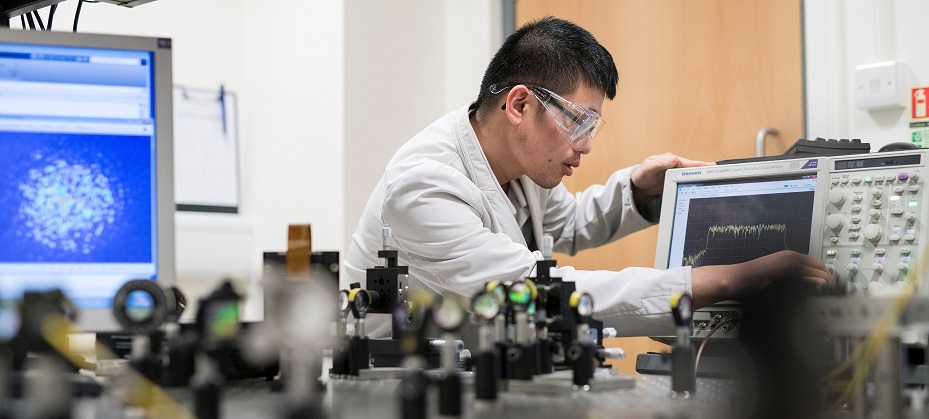
Advancing photonic technologies for sensing, imaging, and intelligent systems
The Photonics Lab at the University of Kent conducts cutting-edge research in optical sensing, ultrafast photonic imaging, microwave photonics, and optical intelligent computing, addressing challenges in communications, biomedical diagnostics, energy, defence, and industrial monitoring.
What we do
Our research focuses on the development of next-generation photonic technologies that enable measurements and signal processing beyond the limits of conventional electronic systems. Key research themes include:
- Optical fibre and photonic sensors
Ultra-sensitive sensing for structural health monitoring, hydrogen safety, energy systems, and industrial environments. - Ultrafast optical imaging and time-stretch systems
High-speed imaging and signal acquisition for biomedical diagnostics and dynamic physical processes. - Microwave photonics and RF sensing
Photonic techniques for wideband RF generation, detection, and spectrum awareness. - Optical and photonic intelligent computing
Photonic reservoir computing and hardware-efficient machine learning for high-throughput sensing and imaging applications.
The Photonics Lab hosts state-of-the-art experimental platforms for high-speed and high-sensitivity photonics research, including:
- Ultrafast laser and time-stretch systems
- High-bandwidth oscilloscopes and RF instrumentation
- Optical fibre sensing and microcavity platforms
- Microwave photonics and optical fibre communications
Our approach
We adopt a systems-level approach, integrating:
- Advanced photonic hardware and instrumentation
- High-speed electronics and signal acquisition
- Data-driven and AI-enabled processing
- Close collaboration with industry, healthcare, and government partners
This enables us to translate lab-scale innovations into robust, application-ready technologies.
Funded Research Projects
Examples of current and recent externally-funded projects include:
- EPIC-BIO (2025-2027) – A two-year international exchanges project funded by the Royal Society aiming to develop ultra-sensitive optical fibre biosensors for single-molecule detection of cancer biomarkers.
- AFCAD (2024-2027) – A three-year InnovateUK and Aerospace Technology Institute (ATI) funded programme aiming to rapidly develop high temperature polymer electrolyte membrane (HTPEM) fuel cell technology for aviation.
- Low-profile ultra-wideband wide-scanning multi-function beam-steerable array antennas (2019-2023) – A three-year EPSRC-funded project aiming to develop a single-aperture ultra-wideband (UWB) phased array capable of operating over an extremely wide range of frequencies, and having a low profile, wide-angle-scanning steerable beams, high gain, high efficiency and multiple polarizations.
Prospective Research Students
We welcome enquiries from PhD and MSc by Research applicants with backgrounds in Electrical & Electronic Engineering, Physics / Applied Physics, Photonics / Optoelectronics, and related STEM disciplines to join a growing research team working at the intersection of photonics, sensing, ultrafast systems, and intelligent optical technologies. A list of example research projects can be found here.
📩 Get in touch to explore collaboration or research opportunities.