BIO-WELL questions and structure
BIO-WELL is a set of 17 questions that allow us to quantify the effect that biodiversity has on people’s wellbeing. All of the 17 questions have been designed and tested so they can be used as standalone items if needed, or together as a set. BIO-WELL has been validated for use both ex situ and in situ: UK English BIO-WELL (for ex situ or in situ delivery). This is the ex situ version:
For each of the following questions, imagine yourself in a nearby forest, at this time of year. We ask you to think about how different elements of this forest make you feel. Please think about the living things, including the plants, fungi and animals (but not pets, horses, cows, sheep) in this forest.
- Encountering the living things in this forest makes me feel…
- The number of living things in this forest makes me feel…
- The variety of living things in this forest makes me feel…
- The interactions between plants, fungi and animals in this forest make me feel…
- The living processes that happen in this forest make me feel…
- The variety of sounds in this forest make me feel…
- The distinctive sounds in this forest make me feel…
- The vivid colours in this forest make me feel…
- The variety of colours in this forest make me feel…
- The maturity of living things in this forest makes me feel…
- The variety of shapes in this forest make me feel…
- The sponginess of living things in this forest makes me feel…
- The variety of textures in this forest make me feel…
- The woody smells in this forest make me feel…
- The variety of smells in this forest make me feel…
- Changes in this season make me feel…
- The presence of animals in this forest makes me feel…
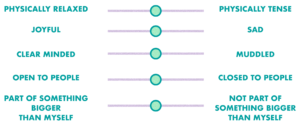
The same response options should be used for each question, capturing physical, emotional, cognitive, social and spiritual wellbeing:
How BIO-WELL was developed
BIO-WELL was developed and tested by researchers from across different academic disciplines, drawing on the experiences of thousands of members of the public. The peer-reviewed journal papers that explain the research process can be read here:
Irvine K.N., Fisher J.C., Bentley P.R., Nawrath M., Dallimer M., Austen G.E., Fish R.D & Davies Z.G. (2023). BIO-WELL: the development and validation of a human wellbeing scale that measures responses to biodiversity. Journal of Environmental Psychology, 85, 101921
https://doi.org/10.1016/j.jenvp.2022.101921
Jones F., Fisher J.C., Austen G.E., Irvine K.N., Dallimer M., Croager L., Nawrath M., Fish R.D & Davies Z.G. (2024). Testing the BIO-WELL scale in situ: measuring human wellbeing responses to biodiversity within forests. Journal of Environmental Psychology, 109, 102897
https://doi.org/10.1016/j.jenvp.2025.102897
Shiny and R package
Questionnaires that incorporate BIO-WELL can be designed and analysed using Shiny and an R package called ‘BIOWELL’. The user-friendly package provides a range of functions that streamline questionnaire development and interpretation. Details about the R package are available via GitHub: https://github.com/r-a-dobson/BIOWELL.